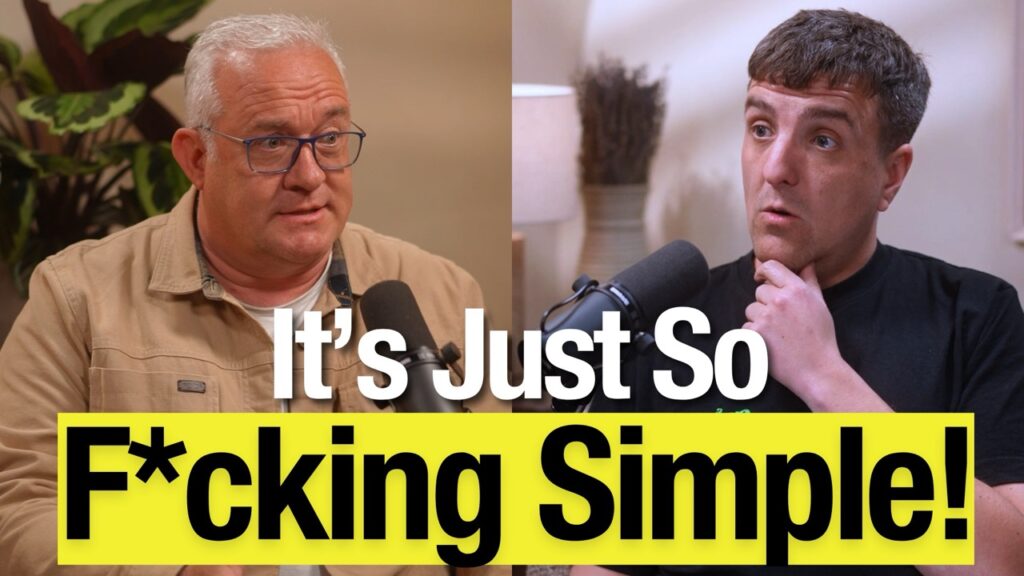

This week’s guest is Ben Knight, founder of Trade Tribe, a paid UK trading community that was around 180 members strong at the time of recording.
He talks through his “medium-term investing” method, the stop-loss system he uses to manage risk, and the returns his members claimed at the time, which we’re presenting here as his account only, not a promise of what anyone else can expect.
Ben spent years day trading full time before he burned out watching charts for six to eight hours a day.
He built a slower, rules-based system instead, one designed to take a few minutes to check each day rather than a full-time job’s worth of screen time. That system became the basis for Trade Tribe, the community he now runs to teach it to others.
In this episode Ben walks through the difference between trading and investing as he defines it, the checklist he uses to shortlist companies, and the stop-loss approach that locks in profit as a trade moves.
He also talks candidly about the returns his clients were seeing at the time of recording and about his own detour into HMO property investing.
We’ve kept his numbers and community details in this article exactly as he stated them, with the caveat that any specific returns are historical claims from one individual, not a result you should expect to replicate.
———
Gains App is LIVE!
An AI-powered budgeting and cashback app designed to help you make more of your money.
Download here: https://gainsapp.onelink.me/8IhT/oiaimr1z
———
Get a FREE FRACTIONAL SHARE worth up £100 when you deposit £1 with Trading 212
https://www.trading212.com/join/MGP
If you don’t receive the free fractional share, head to the menu and put the word ‘MGP’ into the promo code section.
(Capital at risk when you invest)
Key takeaways
- Ben Knight, founder of Trade Tribe, describes his approach as “medium-term investing” rather than day trading: holding positions for roughly six to ten weeks and checking them for a few minutes a day using preset buy and sell levels.
- At the time of recording, Ben said Trade Tribe clients averaged 60 to 80% returns over the prior 12 months. This is his own claim from 2023, not an independent or verified figure, and past performance never guarantees future results.
- Trade Tribe was explicitly a paid community (around 180 members at the time), not a free resource, and access started with a free webinar before any paid programme.
- Ben’s risk approach includes trading no more than four to six positions at once, starting with smaller amounts than planned, and practising on a demo account first.
- Most retail traders lose money. Ben himself described burning out on full-time day trading before building a slower system, and stressed that trading and investing both carry real capital risk.
Timestamps
- [1:18] Ben Knight Introduces Trade Tribe and Five-Minute Investing
- [3:18] Trading vs Investing: Why the Time Frame Is What Matters
- [6:39] Why Ben Calls His Method Medium-Term Investing, Not Trading
- [9:33] The Fundamental 13 Checklist and the Vaccator Spreadsheet
- [17:45] Warren Buffett Style Fundamentals vs Chart-Based Trading
- [19:54] How Trade Tribe Vets New Clients Before They Join
- [22:05] The 80-20 Rule and Managing Position Risk
- [27:09] Ben’s 60-80% Return Claims, at the Time of Recording
- [32:40] From Day Trading Burnout to Building Trade Tribe
- [39:16] Ben’s HMO Property Investing Strategy Explained
Who is Ben Knight and what is Trade Tribe
Ben Knight is the founder of Trade Tribe, a UK-based trading education community that, at the time of this recording, had around 180 members and was explicitly a paid service, not a free one.
Ben describes his role as teaching busy business owners and individuals how to approach the stock market in short daily sessions, using a rules-based system rather than constant screen-watching.
New members were pointed toward a free introductory webinar first, with paid three-month programmes as the next step for anyone who wanted to continue.
Ben is upfront that this is not day trading. He calls his approach “medium-term investing”, typically holding a position for six to ten weeks, sometimes longer, using preset buy and sell levels so that decisions aren’t made emotionally in the moment.
It’s a structured, rules-driven method, but it is still stock market speculation with real money and real downside, and none of the figures Ben quotes in this episode should be treated as typical or guaranteed.
If you’re weighing up trading against a longer-term, lower-maintenance approach to building wealth, our guide to investing for beginners in the UK covers the fundamentals of the slower, buy-and-hold route most people are better suited to.
Trading vs investing: the difference that matters
Ben draws a clear line between trading and investing, and it comes down to time frame rather than the assets involved. In his framing, seconds to weeks is trading, and weeks to months or years is investing.
Day trading, he says, is genuinely difficult: it demands constant attention, real skill, and a tolerance for watching numbers move in real time, which is exactly the environment that pushed him to burn out after years of doing it full time.
His own method sits closer to the investing end of that scale.
Positions are held for weeks rather than seconds, decisions are set in advance using a spreadsheet he calls the “vaccator”, and a stop-loss functions as a safety net: if the price falls to a preset level, the position sells automatically, locking in whatever profit had built up.
It’s a way of removing emotion from decisions, but it doesn’t remove risk.
Every trade can still lose money, and Ben’s own repeated warning in the episode, that jumping into trading without any education is how people lose it, is worth taking at face value.
The Fundamental 13 and how the "vaccator" spreadsheet works
Rather than reading company balance sheets in depth, Ben uses what he calls the Fundamental 13, a 13-point checklist for shortlisting companies, paired with a spreadsheet that tells him when to buy and how much.
He finds candidate stocks using a free US stock screener, and once a company clears his checklist, the spreadsheet dictates entry points and stop-loss levels rather than gut feel.
He contrasts this with a pure Warren Buffett style approach, which involves deep research into a company’s debt, cash flow and competitive position.
Ben’s method, he says, sits in a middle ground: less chart-reading than a day trader, less deep research than a value investor.
It’s a simplified system built for people who don’t want to spend hours on research, but simplifying a decision doesn’t make the underlying risk disappear.
Anyone drawn to this kind of active stock-picking should understand it sits apart from, and is riskier than, a diversified long-term portfolio.
Ben's 60-80% return claims: what he said, and why to be sceptical
Ben told the podcast that Trade Tribe clients averaged between 60% and 80% profit on their starting investments over the 12 months before this recording.
He also referenced this being maintained over roughly three years by the time of the conversation. We’re reporting this because it’s what Ben said on the episode, not because it’s a figure anyone should expect to replicate.
Returns like these, if accurate, would be exceptional by any standard, and they came from a specific market period, a specific strategy, and one person’s account of his own community’s results.
Trading returns are also not evenly distributed. Some people following any given strategy will do better than the average, others will do worse, and some will lose money outright. Independent research consistently shows that most retail traders underperform simple market benchmarks over time.
If you’d rather see how a more modest, steady return compounds over years without the active management, our compound interest calculator is a useful way to picture what a long-term investing approach could realistically build.
Risk management, position sizing and starting small
To his credit, Ben spent real time in the episode on risk controls rather than just returns.
He recommends starting on a demo account with virtual money before risking anything real, then starting with a smaller amount than you’re eventually planning to invest, building confidence before adding more.
On position sizing, he suggests holding no more than four to six trades at once. Fewer than that and you may be missing opportunities, he says, but more than six becomes difficult to monitor and manage.
He also flagged that Trade Tribe’s own client base skewed conservative, tending to keep a larger share of their money in steadier investments and only a smaller portion in his active strategy, an 80-20 split in the opposite direction to what you might expect from a trading community.
That’s a sensible instinct: treating active trading as a small, deliberate slice of your finances rather than the whole plan.
Before committing any money to something new, it’s worth knowing exactly what you can afford to put at risk, and our budgeting calculator is a straightforward way to see what’s actually spare each month.
From day trading burnout to property investing
Trade Tribe exists, by Ben’s own account, because full-time day trading made him miserable.
He describes years spent watching charts for six to eight hours a day, isolated and stressed, before deciding he could accept making somewhat less money in exchange for far more of his time back.
Building a slower, rules-based system was how he got there, and teaching it to others became the business.
He also spoke about a detour into HMO (house in multiple occupation) property investing, which he entered soon after leaving full-time trading.
He’s candid that property turned out not to be his passion: it’s cash-flow positive when it works, but comes with tenants, contracts and problems that don’t exist in a spreadsheet-driven stock strategy.
His conclusion, that property demands a very different and more hands-on skill set than the stock market, is a fair one for anyone weighing up where to put their time as well as their money.
This transcript is auto-generated and lightly edited for readability, it may contain errors.
[0:00] Sammie Ellard-King: Hello and welcome to another episode of the Money Gains Podcast. This is your host, Sammie Ellard-King, and today I’m joined by Ben Knight, who is from the Trade Tribe. Now we have a really interesting conversation on our hands here. Now, when I say trade, it’s not necessarily trading. He does something called medium-term investing. Now, this is really, really interesting. It’s like picking up a brand new skill. I asked him loads of questions selfishly, of course, because I was really interested in learning about this. And actually, his success rate at the moment is incredible. He’s getting 70% on average returns on a year, which is just mind-blowing, really, when you think about it. And yeah, we have a really good chat. We will talk about his property investments too. There’s loads of beautiful little nuggets in there for people that are interested in this sort of thing. So if you are listening on YouTube, please do whack that subscribe button. And if you are listening on Spotify or Apple, hit the follow button. It really does help the show. But for now, let’s get started on the Money Gains Podcast. So Ben, welcome to the Money Gains Podcast, man. How are you doing? You well?
[1:18] Ben Knight: I’m really well, man. Thank you very much for having me. Yeah, I’m really excited about this one. I was just saying purely selfish reasons for having you on. I am buzzing to learn all about the trade tribe and yeah, how you’re helping people. But if you wouldn’t mind giving people just a little 411 into you. Yeah, absolutely, man. So um, firstly, thank you very much for having me on today. So my name is Ben Knight, and I teach busy business owners how to invest in the stock market in less than five minutes a day. So you’re talking about nice and easy, right? Wicked, man. I mean, like, that sounds unbelievable. How does it actually work? Well, to be fair, the only way it can work, and the only way you can do anything in under five minutes a day is if you keep it simple. So, as you might, or anybody who’s ever looked into like trading or investing in any form would realise there’s a lot of complexity out there, a lot of jargon, a lot of fluff, as I like to call it really. But I think people use that just because they like to sound smart. So when you actually cut that bit out, it’s actually very simple, the basic principles, and you stick to them and you can easily achieve, I would say, good results with not a huge amount of knowledge.
[2:26] Sammie Ellard-King: Does that make sense? Yeah, of course. Yeah. I mean, I’ve delved into trading myself on a few occasions, had some success, had some losses. I just, I think the stress of it for me, because I was like trying to, I think I was pushing it. And I think that’s one thing that like a lot of um a lot of people fail because they they you know they go in with their, you know, let’s say you start with a grand and then they’re like they put the grand on the trade and it’s like you know, sweat pouring down your brow, you see it start going down, you’re like, do I back out? And you know, it’s it’s it is it is a skill, it’s a complete skill. Um, and it’s a learned skill as well. You know, we had Sam North from eToro on who’s uh been in trading for years, and he he was saying, you know, it’s like it’s like driving driving a car or reading in the learned a language, you you really do need to learn the tricks of the trade. Would you say that’s true?
[3:18] Ben Knight: Yeah, absolutely. I think it does depend on what your outcome is. So, what I mean by that is if you’re just looking to make an income on the side, like an investment, why I would call it, where it can build in the background, you’re not looking to touch it anytime soon, you just want to build that sort of security put on the side, that takes a lot less skill and knowledge than if you’re day trading when you’re in front of your screen all day watching the lines go up and down, panicking. Like that’s the other side of the coin. So, from what he said there, I would agree that side is more like I always use this example. It’d be like kicking a football for the first time and then expecting to play in the Premier League the next weekend. Like it would be nuts, wouldn’t it? You wouldn’t think that. But people with trading, they do a couple of like demo trades and like, oh, this is easy, let me uh jump in at the deep end, and that’s when they lose money, unfortunately.
[4:04] Sammie Ellard-King: So let’s say I’m coming to you today, you know, I drop you a line on your website and I say, I want to learn how to trade in five minutes. What’s the steps that we go through? So, first thing I always do is get people to attend one of my free sessions, just because I believe you should always get a bit of a peek behind the curtain before you commit to anything, because some people might look at what I do and be like, oh, that looks awful. I’d hate to do that. It doesn’t align with me at all. Whereas some people might look at it and be like, oh, I can actually imagine myself doing that. So I think that’s very, very important because I think trading or investing as a whole has an image in people’s minds, you know, like the Lamborghinis, the clubs in Dubai, that kind of rubbish. And that might actually be not the reality at all, which obviously, as we know, it generally isn’t. Um, but the reality might not be what people want, or actually it might suit them a lot better because they’re like, I don’t like I know that stuff’s a bit of a well, we know what that is, but the Instagram. We know it’s not the reality. Yeah, yeah. Yeah, yeah, that’s the one. So I always say to people, come and do something free first, like just get a taste of it. Because I mean, you might hate me, you might not like my presenting style, you might not like, and while I’m kind of joking, I’m also like quite serious because people jump into things just on the face of it and like the promise of whatever it may be, but it’s actually the intricacies that make the result, right? If you don’t like the person I’m teaching you, or you don’t like how the thing’s structured, or you’re terrible at one certain thing that it doesn’t, you know, that kind of thing, you’re not gonna get good results. No. Whereas the opposite’s true. If you quite like the person, you can listen to them, you can learn from them, if you can understand the basics, you’re happy to keep things simple, then you know, then you are gonna be successful. It’s just about setting yourself up for success at the beginning.
[5:48] Sammie Ellard-King: That’s totally true, man. So, you know, they’ve jumped on this free session, they’ve enjoyed it, then what happens? So, next step after that, people can join one of my three-month programs. And what the whole goal is of any of my three-month programs is you learn my strategy and master it so that you never need another program again. Right. I’m not a fan of you know, you have to keep subscribing to something to keep getting the result. I want people to learn a skill because you know, touch wood, if I got hit by a bus tomorrow, I want people to still be able to get results, right? I don’t want it to be reliant on me. Um, and it all stems back to I believe nobody will ever care about your money as much as you will. Yeah. So it’s best to have the skill yourself. So I don’t know what you feel about that, but like I’m not a fan of like the copy trading stuff where you like someone just sends you what they’re doing, you just copy them. That’s not a skill. And sooner or later they’re gonna get it wrong, and then you’ve got to deal with that.
[6:39] Sammie Ellard-King: So you see all these like Discord groups and telegram chats, and they’re like, you know, buy now, buy now, sell now, sell now, and like you know, I’m sure some of them have done pretty well for themselves or whatever, but in at the end of the day, it’s just it’s not what people don’t have a time, and this is what you’re giving them, right? You’re giving them time back in the day. This is a lunchtime thing, a morning thing that people can do. Um, so when you say five minutes, like that’s a very short space of time for a trade, you know, trades run from a matter of seconds to you know how you can keep a trade for your whole life if you really want. Um why five minutes and what what’s the kind of goal with that? Yeah, it’s a really good question. So this is actually because we’re in trades for a lot longer than you might imagine. So we’re not doing the day trading, we’re not in and out in seconds doing all that stuff because that stuff takes time. Sounds ridiculous, but to be in a trade for seconds, you need to be monitoring it for hours and getting it the right place. Like we haven’t got time for that. So we’re actually in trades for a bit of a longer period of time, so it could be like six weeks to ten weeks, or even a bit longer, maybe like that sort of time frame. Now I actually call it medium-term investing rather than like trading traders, because we are doing it over a longer period of time. Now, the benefit of that is you’re not really that active day to day. Yeah, if you’ve put your lines where I’m gonna buy, where I’m gonna sell, you’re just checking it in a few seconds each day, that’s a lot easier to manage than having to be in front of your computer, making sure you’re watching what’s happening, all that stuff. That’s when one, it takes a lot of time, but two, that’s when it gets emotional as well. Now, you probably agree with this, emotions are the number one biggest reason people fail with investing or anything, because that’s when you panic, like, oh, I should I feel like I should get out now, or feel like I should get in. The market doesn’t care how you feel. That’s that it’s kind of irrelevant. So, yeah, by having that very structured system that, like, when it gets to here, you’re gonna do this. When it gets to here, you’re gonna do this, and you just check it in a few seconds. That’s how we make sure it’s less than five minutes a day, often quite a lot less.
[8:41] Sammie Ellard-King: And with these programs, you can kind of set those parameters already so it can auto-sell for you at a certain number and yeah, yeah, you can sell it. Yeah, yeah, absolutely. Like so, a term that would use here would be like a limit order. Now, for anyone who doesn’t know a limit order is where you say, right, when the price gets here, I want you to buy it for me, essentially. That’s what you’re saying to the broker, so that they have to give you that price or better. Meaning you could be at work on holiday, you know, dropping the kids to school, whatever it is, and it would still do it for you. You don’t need to be sitting in front of the screen. That’s a massive time saver. And I’m big on all the trying to automate it as much as possible. Yeah. Okay. And so let’s say, for example, stock is £100 and we’re looking to, but let’s say we’re putting £100 in. Stock’s £100, we’re putting £100 in. What um what are we looking for here and on the charts that’s kind of taking us to the next level?
[9:33] Ben Knight: Yeah, great, great point. So what my strategy is based around is well, two tools. One of them’s called the Fundamental 13. That’s how we find companies, which we can talk about in a sec. Um, and the second half is about the vaccator. Now, this is a spreadsheet I’ve created that tells you when to buy and how much to buy. Okay. Again, removing emotion and saving some time. So basically, you’re just following what the spreadsheet says to do at the certain points. So, in your example, if you bought a stock for £100 and it and you had £100, obviously you buy one stock, you buy one share. Now, with that, if it goes up a certain amount, that’s when you can choose to sell it, you can choose to keep it, whatever. But we’ve got quite a strategy on that. So it’s like if it rises to this percentage profit, I want you to do X. Now, X in this case would be something called a stop loss. Now, for those who don’t know what a stop loss is, it’s kind of like a safety net. That’s how I like to think of it. Where you say, right, you put it under on your uh stock, and if it falls, if price falls and hits this safety net, the broker will sell it automatically for you. So as the name suggests, stops your losses, right? Um now we actually use it to lock in profit because if you’re in, I’m gonna use easy numbers here, let’s say you’re in 20% profit on a trade, you could sell it then and there, which is what a lot of people do, but then you’re limiting your profits. You’re saying, right, well, I can’t get more than 20% now, I’m out. Which might be fine for you. But if you put a stop loss in or a safety net in at 15% profit, you’re saying, right, well, worst case scenario, if price comes and hits this, I’ll get 15% and you know, happy days. Or the alternative is it could keep going up and then I could keep moving up my safety net so I could lock in more and more profit. For me, that works a lot better because you don’t miss out on any of like the you know, the crazy ones that just shoot up and stuff like that.
[11:16] Sammie Ellard-King: I saw you post one the other day, and you said, Oh, this is one’s done really well, and it had gone up, but then it gone back down, but then it flew up to 30, 40%. I think you traded out at like 26 or 27%. And I was so that’s what you’ve done. You you’ve taken your money off the table, so your profits off the table, essentially, or portion of it.
[12:21] Ben Knight: Yeah, exactly that. I’ve said, look, if it comes down and hits this line, I’m out and I’m cool with that. But if it does continue up, I’m I’m cool with that too. In that case, it did fall and hit my stop loss, so it sold it for me. I’ve got my profit, and there was no emotion. I just followed the strategy. So that’s a nice feeling. That’s if that makes sense. Yeah, no, it is, it is, it is it’s a different way. See, it goes up, you can then reset your stop loss at that at a slightly lower point, I would imagine. Is that right? Or and then you and then you know, right, okay, if it drops down to that, then I’m out, but I’ve got the profit. And then if if it keeps going up, I’m not lost, I haven’t lost anything out here. I’m just I’m just happy, really. Yeah, exactly. So it’s kind of like a win-win, essentially. Yeah, the worst case is you’re gonna get your profit that you’ve locked in.
[13:07] Sammie Ellard-King: So look, I I think there’s a big hoodoo around this because trading is seen, you know, a lot of people we’ve had on the podcast, big financial experts, be like, don’t trade. What would you say to that? I well, my answer would be dependent on what you call trading, right? So you’ll hear me say like investing and trading. The difference is time frame. So for anyone who doesn’t know, the only difference between trading and investing is how long you’re in it. All right, so I would say seconds to days, maybe to weeks is trading, and then weeks to months to years would be investing. That’s sort of like the line. Now, trading is a hard skill, like don’t get me wrong, like that’s kind of what I was talking about earlier about the Premier League kind of thing. Like, it is tough, and people do jump in too early without the right education. But investing is a lot simpler purely because you’re not under pressure, but that time frame being so much stretched is so much more beneficial to you because you don’t, it’s not like second to second, if you make a mistake, you’re out, you’ve messed it up. It’s like I’ve got a few days or weeks to make this decision here, like this isn’t like make or break. So trading is very, very difficult, I will say, like transparently. Investing is a lot easier, but both will depend on what strategy you’re following. Absolutely.
[14:20] Sammie Ellard-King: So this is super interesting. So we’re kind of putting the hoodoo to bed here, really, by saying that we’re not necessarily trading, we are opening a trade, but we’re not trading here. We’re we’re investing with a viewpoint. We’ve watched this company, I would imagine, over a period of time. We know where you know there’s something called support. I I’m probably jumping in ahead of you here, but uh I love it. I I really enjoy it because it’s just it’s it’s fun to watch um and and be involved in as well. So you know it’s hitting this line, and you know that that’s when you want to buy from, right? And do you want to talk a little bit about that? Is that yeah, sure. So what you’re referencing there is support and resistance. So for those of you who don’t know, it’s kind of looking for a pattern on the chart where I call it like a floor and a ceiling. So, for example, if a if a stock always seems to bounce off of one certain price, like the ball bouncing on the floor, that would be a support. If it bounces off uh a top one, that’d be a resistance, like a ceiling, essentially. That’s kind of what support and resistance are. I actually don’t utilise that kind of stuff as much as you might think. Okay, interesting. Um, because yeah, they’re fantastic, don’t get me wrong, support and resistance are amazing, but they’re very trading based. Whereas what I’m doing, like I mentioned that spreadsheet earlier, when it says when it gets to this price, you’re gonna buy this many, that’s what I’m looking at. Um, and it won’t take into account things like support and resistance, it’ll be very much more about more maths kind of stuff, but because it does it for me, it’s nice and easy. Now, the reason I’d or how I would liken this is like Warren Buffett, for example, I’m sure most people have heard of Warren Buffett, probably the most famous investor in the world. He’s not sitting looking at charts all day. Yeah, he’s looking at like the company, the fundamentals of it. Yeah, which is a slightly more of the angle we take. Interesting. Um yeah, so basically, broadly speaking, if you pick a solid company and you’re gonna be you’re prepared to be in it for a few weeks, months, likelihood is it’s gonna come back up, right? You don’t really care if it drops a little bit first or go. Yeah. So that’s the premise of this. Right.
[16:25] Sammie Ellard-King: Hey guys, Sammie here. Just a quick one. If you wouldn’t mind heading over to upthegains.co.uk, hitting the subscribe button in the top right hand corner, and entering your email into the box. For your troubles, you will receive a free net worth calculator worth £25. Now, this net worth calculator, if you enter your assets and your liabilities, will tell you exactly how much you are worth today. Now, what you can also do is set yourself some financial goals and track your net worth along the way using this tool. It’s totally free. So head on over to upthegains.co.uk, hit the subscribe button, pop your email in, and you’ll be sent straight to your inbox in a matter of minutes. Now, back to the podcast. Right, okay, so this changes everything then. So I’m gonna leave that where that question where it where it lies. So this is what I do, but I do it on a long, long time frame. So I’m looking for, let’s say I I love fintech companies, so I’ll go in, I’ll look at the company fundamentals, their debt, their balance sheet, you know, their their cash flow, and what essentially they’re trying to do over the long term, whether it’s product, what kind of moat they’ve got essentially around their company, and then whether if I like it and the price is right, I’ll buy into it a certain amount. Are we utilising more of this now?
[17:45] Ben Knight: I’m gonna say it’s a bit of a happy middle ground because what you’re doing not to sit on the fence here, but what you’re doing would be way more Warren Buffett style, right? Yeah, yeah. For me, that’s way more research than I do. Okay. However, so what I have is so I’m not a fan of reading reports, balance sheets, all of that. I think you can get lost in endless amounts of information, uh, which you might have experienced yourself. There’s a lot out there. Yeah, yeah, there’s so much, so much. Yeah, so what I did for myself, I actually structured um a checklist of what I look for in a company. It’s kind of like a criteria, right? So it’s a 13-point checklist of the fundamentals of a company. And I’m I sort of referenced it earlier, the fundamental 13. And it’s if a company meets this, this, this, this, and this, it’s good. That’s kind of how we work, right? So again, removing a lot of the time it takes because you’re only looking for 13 pieces of information. And if it falls within your criteria, it’s cool, it’s good to go. Right. Okay. Does that make a bit more sense? It’s kind of it’s not quite technical and it’s not quite all fundamentals in the middle, yeah.
[18:52] Sammie Ellard-King: I love it. So you’ve changed the mantra here, so we’re kind of falling. I’ve never met anybody that falls in the middle, so this is interesting. So what what um what so we’re we’ve we’re going down this, we’ve identified the company, we’re going down this checklist. Then you use your spreadsheet to set the buy price, and do you also then tell them the sell price as part of that too? Is that how it works? Uh similar. So actually, we just follow the same profit-taking strategy for every trade. So it’s that stop loss that we talked about earlier. Like when it gets to X percent, you’re going to put your stop loss there. When it gets to moves up to that percent, then you’re going to move it there. It’s just incrementally bumping it up along the way. Wow. Okay, this is super interesting. So, where are you finding these businesses? So, a free stock screen, you could obviously use any stock screen you like, but I use one called finviz.com, so f-i-n-v-i-z. Um, they only do American stocks on there, and I only do invest in the US stock market. Um, but it’s a really good resource. It’s a bit bit old-fashioned, looks a little bit clunky, but it’s just super easy to find what you’re looking for.
[19:54] Sammie Ellard-King: Do you if I if I come to you today, do you kind of go, do you check people out and that they’re comfortable making these kind of decisions before you jump in with them? Yeah, so I and my team have a bit of a I guess it’s a criteria ourselves, really, for what we’re looking for in client, because we do have an extremely high success rate. And I’m very keen to maintain that, as you might imagine. Um, so yeah, when we’re talking to people on the phone, and it’s not like, oh, I want to join you like great, you’re in. It’s very much a all right, well, transparently, this is what you should expect, this is what a day-to-day would look like, um, that kind of thing. Just to feel a bit more out because I wouldn’t want someone to do something that they hated as well. That wouldn’t work for anyone either. So, yeah, do have to be very not not super strict, that’s not the words, but just to make sure people are aware and they have all the information, I think that’s a good way to proceed with it.
[20:53] Sammie Ellard-King: You’re not after the geezer that wants to buy Bitcoin for his life, put it that way, right? Like you’re not after the get-rich-quick guys, right? No, I mean uh you’re you’re right. So when only in my like three webinars I talked about, like in the first five minutes I’m saying, look, if you’re looking for to be trading and sprawled off across a Lamborghini within the next few days, like this isn’t the right place for you, like this kind of thing. But if you’re looking to build real investments to create freedom in your like your life for you and your family, like you’re in the right place. That’s the kind of thing. I think setting those expectations early on, it’s done well for us so far. The people who aren’t right for it, they disqualify themselves, and the people who it is right for, they they move towards us. What’s interesting here is that like you could still say do your trade tribe program, and then you could also still have, you know, I follow an 80-20 rule, so I’ve got 80 index funds, and that just ticks over, and that’s my safe wealth. And then my 20% is individual stock picks out of my portfolio, and that’s what I just really enjoyed doing. And I suppose you could still follow that mantle with you, really, and like that your 20% of money could be towards the trades and the medium-term investments, and you’ve still got your other stuff ticking over. It doesn’t have to be all in with you, right?
[22:05] Ben Knight: Absolutely, yeah. I mean, I think if I had to think of all our clients, what people are doing, it’d probably be more 80-20 the other way for us. Interesting. It’d be like because this is transparent, this is a low-risk strategy. It’s not it’s not gonna get you rich by next week, by next Monday. Like it’s not that. It’s quite low risk. So people do tend to edge towards a larger portion of their funds to put into it. Um, but only once they build their um confidence. So you’ve actually touched on a good point there. At the start, obviously, I’ll get people to start on a demo account. Yeah, I would say that to anyone getting into any trade and investing. Start on a demo account, which is a virtual account, you play with virtual money and you can experience and make your mistakes without. Having anything at risk. That’s the first step. Then when they do start, I always say to people, because everyone wants to know how much should I start with with investing? And always say, start with less than you imagine. Because you what you should do, you’re not in a rush. That’s a key thing here. So do your first couple of trades with less than you usually do. Build your confidence, get your profits back, feel good in yourself that you’re doing it right, and then you can add to it later. I think people worry so much about getting it all in on day one and I have to be making profit. That’s such a bad way to approach it, right? Um so yeah, I I find that if you can just build up like that and then yeah, if you start at 80-20 and then maybe you start scaling it the other way, that’s a way to do it too. But you’re you’re absolutely correct in that.
[23:25] Sammie Ellard-King: So I imagine you’ve ever let’s say I’ve got you know some money and I’m putting it in with you. We’re not going all in on one, are we? Or are we going, are we trying to diversify this as well, so we are mitigating our risk, slightly. Yeah, that’s a good point. So I suggest the optimal amount of trades is between four and six at the same time, is what I tell my clients. Because if you’ve got less than four because there’s less than four good opportunities, then that’s fine. Yeah, if there’s one good opportunity, just have one and have some cash sitting there, that’s fine. But if you’ve got four to six, there’s always something happening, it keeps it interesting, right? Like one of them’s moving up, one’s moving down, it keeps you engaged. But above six, I say don’t, just because it takes up too much headspace. Like, I don’t know why. Seven and above is just hard to monitor. It becomes a little bit overwhelming, all the information, you forget things. Whereas most people, everyone who I work with is doing this to build it in the background. They don’t want to be like a full-time trader or anything. That’s not what they’re here for. They don’t want a part-time job, they’re already busy. Yeah, so having maximum six, maybe even five, just keeps it super manageable for you.
[25:38] Sammie Ellard-King: So I love this. So you can jump on, you’ve not got any you’re doing five minutes a day, you’ve not got the risk that you’re taking with short-term trades, you’re looking at this from a fundamentals perspective. I don’t know what that is at the 13, the fundamental 13, but you know, we’re we’re we’re looking at this from a little from a position of you know mathematical basis, which makes a big difference. Oh, my light’s just gone off. There you go, look, dark face out. Uh sorry. Um, yeah, basically, the um there’s there’s reasoning behind this, which is a big, big difference, and uh that’s what I love about this man. So if people want to get started, what’s the first step? So we we go on this free webinar and then they then they jump on a is it kind of one-on-one with you or uh that’s a group webinar, so we usually get well between 20 and 50 people attending each webinar, and it’s a chance for me to one, show people what investing is actually like, two, to show them actually points of the strategy, because I want people to see, like, oh, I could imagine myself doing that, or I couldn’t imagine myself doing that. Either way, that’s fine. And then I also give some wealth habits as well on those sessions because I like people to have things to implement immediately, because you’re not gonna obviously master the strategy in one hour or whatever on a webinar, but you can have things to take away and implement in your life that’s just gonna make a difference regardless of whether you do this strategy or not. So I quite like that. It’s kind of like instant wins, medium wins, and then long-term wins as well.
[27:09] Sammie Ellard-King: I see I’ve seen on the uh uh on the About Us page, you know, you say that you’re getting 70% returns. Is that is that about right at the moment? Yeah, so in the last 12 months, we were averaging between 60 and 80% um profit on beginning investments for clients. Yeah. Obviously, that’s when this goes out, this maintained, yeah. Yeah, I know it’s backward and all that. But you know, it’s been over three years now on those scales, so yeah, and that’s obviously through whatever happened in 2020 and all that good stuff as well. So it’s been it’s been awesome to see. Um, and I think when people hear 60 to 80 percent, we see one of two very different reactions. One of them’s either, oh, that’s not enough, I’m not interested. I heard I could, you know, retire by next Monday. We can’t cry. Yeah, all right, fair enough. That’s cool. Then that’s not the right thing. Um, and then other people are like, wow, that’s a lot. Like I’m like making 20 to 30 percent in some other investments I’ve got, so this would be a nice thing on the side. Either way, I think you know which sort of camp you fall into with that, each person.
[28:20] Sammie Ellard-King: Um I love that though. So six, I mean that they’re they’re that’s big numbers, man. Like, you know, it’s it’s not a small fry at all. You know, a lot of people average 10 to 15 percent and they’re happy with those. So, you know, 70% is is huge. Yeah, I mean, again, it I I think it’s great, like I’m very happy with it. But but you’d be amazed at how many conversations I had that for some people that’s just not enough. And I’m like, that’s cool. Like, if that’s your risk profile, by all means, go go and do what you need to do. Um, but I know with that achieving those percentages consistently, you can build something pretty spectacular. You mentioned something there which I think is very interesting to touch upon here, is that you know we went through a very rough period last year, you know, the markets were down overall, they’ve come back some uh somewhat this year, it’s been a great year so far. Um, you know, I was thinking I was hey, the NASDAQ was up like 30 something percent. And I was just like, what is going on? But we had a huge drop last year. So, in that time frame when the markets are, you know, there’s fear everywhere, and everything seems to be going down, from even you know, your Apples and your Microsoft’s etc. Yeah, what’s um what happens in that time frame? Do we back off a bit? Do we look for elsewhere for opportunity?
[29:39] Ben Knight: Yeah, it’s interesting because weirdly, uh probably our best years have come in those times. Oh, cool. Here we go. The reason being is because broadly speaking, if everything’s down like you’re saying, everything’s on a discount, right? So if you’ve got I I’ll use Google because that’s a great example that you said. Like Google is a great company, generally speaking, right? I think if you look at the fundamentals, very, very strong. I always use this example. If there was World War III tomorrow, they’d probably be alright. That kind of company, right? Like super safe. Now, if overnight Google tanks and the world goes crazy and they drop 30%, 40%, well, it’s like if you were looking at your favourite car to buy, and then suddenly they did a flash sale and it was like 40% off, you’d be mad not to go and buy it. You’d be like, of course I’m gonna buy it, or your favourite pair of shoes, whatever it may be. But when it’s a stock or a company, people are like, ooh, well, that’s a bit risky, it’s dropped a lot. Well, it’s not really, it’s a bit of a mindset shift. It’s the same company that it was yesterday. Circumstances are a bit different, but if it is that good of a company, it is on a discount, and you know, if you’re buying it now, you’re probably gonna do alright. So, with that mentality in mind, when things do fall and they still meet our criteria, it’s kind of like happy days. I’m getting it much cheaper than I’d anticipated to. So you’re just buying a discount, basically. Essentially that, right? Yeah, exactly. And but the key is you have to be selecting fundamentally strong companies because in those bad times, the bad ones don’t last.
[31:04] Sammie Ellard-King: That is a no, no, no, they don’t. No, no, that’s the thing. So there is an element of of debt and etc. in there, and uh, you know, how has it been performing over a long period of time, I would imagine. Yeah, yeah, absolutely. So we actually, as a reference point, I actually do look back back to March 2020 because well, I’m sure everyone remembers, world went a little bit crazy. Um, and the stock market did change since then. I truly believe it did. Everything behaved differently afterwards, and using that as a reference point, like, look, when the world’s gone mad, this is what’s happened to this stock. It’s quite a good reference point to look at and be like, okay, well, yeah, you know, on a normal day, it’s probably not gonna do much more crazy things than that. So it’s good to it’s good to have that rather than just guessing, like, oh no, Apple’s a strong company, so I’ll just buy Apple. That’s not a good way to do it, which is what most people do.
[31:55] Sammie Ellard-King: So interesting, man. Um, it’s got my brain cogs going thinking about these things. Like it is just so cool because you know, we we come on here and we often have guests that you know either one side of the spectrum or the other, most of them are index funds only, and you know, that’s totally fine if that’s your strategy and you just want to crack on with things, but there are so many other avenues for people to explore, and this is definitely one of them if you want to, you know, if you want to learn, and uh a lot of people do. And so I noticed on your site, I’m gonna slightly change this. Um, you you speak about property um and uh and investing in in property. How how’s that been for you? And how is it at the current uh in the current market as well?
[32:40] Ben Knight: Um, yeah, prophecy is an interesting one. So I’ll uh I’ll give a little bit of a backstory on that of how that came about because that was actually how the Trade Tribe began. So for those who don’t know, I used to be full-time in trading, like that’s all I was doing, sole source of income. And that was like day trading, day trading, like in front of your screen for six to eight hours, you know, all that stuff. And I hated it. I I I genuinely hated it. Like the money’s one thing, but when you’re just watching lines go up and down for hours every day, like it’s it’s lonely. It’s like it’s not a good mentally, it’s not a great place to be. So I was like, right, I can’t keep doing this. I’m I’m miserable. I like people, I like talking to people, I don’t want to be I I can afford to have less money but more happiness. That was quite like a big moment for me. Like uh there’s a there’s a scale here. So I was like, right, let me figure out how I can still make money from trading but in a lot less time, which is when I developed this strategy that takes five minutes a day. I I just made it out of necessity to get me out of the career. Um so yeah, made that and I was like, great, well, I can continue to make some profits in five minutes a day. And then I was like, well, what do I what do I do next? What’s the next thing? And I was like, oh well, if I’m an investor, I guess property is the other obvious thing to get into, right? Um so yeah, got into property, joined some um groups. I think one thing I’ve always ever done is whenever I want to learn something, I surround myself with people who are already doing it. So joining communities, I think that’s like the fastest shortcut to success with things. And I jumped into some property networks and learned some stuff pretty quickly, started to get involved, and then I think my first what was it? My first offer I put in was on the 15th of March 2020, which was maybe like a few days before we went into uh yeah, not the best time to get into a property network. So yeah, that that wasn’t the best start to it. But one thing that came from it was being in the property network, because everyone’s like, oh, you trade, could you teach me how to do this? Could you teach me how to do that? And I was like, ah, great. Well, here’s a business I can do to actually help other people do this, because you know, things are looking a bit ropey at the moment with the world as it was looking at. Everyone was at home, everyone was at home, yeah, couldn’t get the deals over the line and that sort of thing, property, so they were looking for something to do, and I was like, wow, this is the perfect thing. So that’s actually where the trade tribe was born. Um, I have continued property on the side since then. One thing I will say is property is definitely not my passion. I’ve learned that. So it’s good, it’s um, it’s a good vehicle, don’t get me wrong. But there’s a lot of problems that come with property as well. I’ve noticed I’m quite a positive person, I would say. And Savvy, you seem like you’re a positive guy. In property, you only hear from people when something goes wrong. Yeah. Yeah. Which is not the most ideal day-to-day running. People who run property successfully, hats off to them because the mental side of it is very, very strong. Like that it has to be. But yeah, for me, it was like this doesn’t really align with what I like. So while I have got some still running and I’ll keep them, it’s not my active investments anymore, put it that way.
[35:46] Sammie Ellard-King: So you see, you bought you bought one, was that with profits from work, etc., and then you’ve got into it with an investment mindset, or did you have your own home before? Or well, exactly that. So um exactly the first one. So I was like, right, I’ve made some money with trading, like, let me get this into property because it’s safe, as people think. Yes. Um started doing that. Then I actually got very I became very well aware, and this lines up with what we talked about earlier, like that I just didn’t have a lot of experience. Like I’d learnt a strategy or thought I’d learn a strategy, but didn’t really have a lot of experience in this, and I was like, there’s quite a lot to learn in this game. So I carried on the purchase side, but then also started like a property management company at the same time because I thought, well, I can start learning the trade without actually having that much risk because I’m gonna be very involved in property, but with other people’s. So I did that to sort of boost my knowledge as quick as possible. Um, so there was that side of the things going on there, but yeah, I don’t think I’m gonna be focusing too much more on property investing in the foreseeable, obviously, with things as crazy as they are at the moment. I know interest rates and all that don’t lend itself to it so well. And for me, I really like well, obviously, I love the stocks, that that just as it goes without saying, but and I do apologise for anyone listening to this, but it’s because there’s no people involved. People complicate things, right? But when it’s you, you’ve picked a company, it’s met your criteria, and you bought it, there isn’t anyone that could mess up for you on your behalf. Yeah, which sounds a bit silly, but it is a real problem, I would say, in property. So there is that. Now, on the um you said about owning your own home.
[37:30] Sammie Ellard-King: Could you not pay someone to manage it for you? Or yeah, there’s definitely that, but I think every step of the process, because there’s a lot of people involved in anything to go wrong, it could be a buyer, it could be a tenant, you know, all of that stuff. It could uh it’s it’s it’s a lot, it’s a full-time job. Anyone who gets into property and thinks it’s gonna be an easy source of income is in for a shock, I would say. Oh, for sure, man. It’s nuts, like the background that goes on, and you know, vetting the tenants, getting all the contracts done, making sure they pay. If they don’t pay, you’re actually light, like you’re you you can’t get them out for two, three months, sometimes even longer in some cases. And it’s you know, we you we hear all these horror stories, but we also hear all these success stories, so it’s good to hear both sides. So, yeah, if you’re jumping in, be ready.
[38:19] Ben Knight: That’s it. Yeah, I mean, Look everyone, property is an amazing vehicle for wealth, but just be prepared that you’re gonna have to get very good at it and probably learn a lot along the way. I think that’s fair to put it that way. Have you bought close to you? No, so I’m actually I I’m based in Hertfordshire, just above London. Okay, I was I grew up in St Albans, so Oh, did you? I’m in Borehamwood. Oh, right, okay. Well, I I say St. Albans, but I was uh in between St. Albans and Borehamwood, so very close. But I was doing well, I’m doing property in Leicester. Okay. So reason being obviously prices are very, very different up there, demand’s different, everything like that. So it just suited what I was doing at the time. That obviously comes with its own challenges. So you do have to have people on the ground, obviously, it doesn’t seem to because I’m not going to go there just to open the door for people, that kind of thing. But yeah, so maybe that adds a layer of it. If you’re nearer, maybe it’s a little bit easier for people.
[39:16] Sammie Ellard-King: It’s so interesting to ask, you know, it’s something that I’m really looking into at the moment and I’ve held off simply because the buy-to-let rate I was getting 7.1% the other day. And I was like, Well, I can’t really charge this person two and a half grand in rent because it doesn’t warrant that, you know. It’s probably like 1.8 I could probably charge them. And it was like, well, you know, there’s no way and that, you know, how on earth I’m not going to take a £700 hit on this. So, you know, what what why am I going to do it? And a lot of people can’t at the moment. Are you are you finding it difficult to kind of balance this at the moment? So it does definitely does depend on what strategy you’re using. So if you’re doing buy-to-lets, in my opinion, and obviously everyone’s different with their strategy, you I wouldn’t be getting into buy-to-lets for cash flow. It would have to be for the capital appreciation, like meaning if I buy the house now, what’s it gonna be worth in 10 years’ time, that kind of thing. That would be my because you don’t get a lot of cash flow from buy-to-lets, that’s just generally speaking, that. Um I’m doing HMOs, so it’s House in Multiple Occupation, yes, for anyone who doesn’t know. So basically a few people living in the same house now. I I have a young professional living in there. So we’ve got a few seven-bed houses, six-bed, and it’s different, it’s a very different strategy because you’ve obviously got a lot more tenants to deal with. Um, it’s better for cash flow, but for the capital appreciation side, it’s not as good. So, again, everything’s got its pluses and minuses there.
[40:43] Sammie Ellard-King: So you’re charged by a room. Yes, exactly. And then does that then force the overall rent higher than what you could charge, say, the family living there? Yeah, absolutely. Definitely, definitely does. Obviously, you incur a lot more costs because you’ve suddenly got a lot more people living there and everything goes along with that. Um, but yeah, it’s it’s a very different strategy. Yeah, yeah, yeah. That’s it. Oh, it’s interesting. Yeah, no, I’d uh I I uh I saw you put that on the website. I thought I’d better ask about it because uh you know a lot of people listening to this would love to have investments in property, or you know, they might want to join the trade tribe, put their profits into property eventually. So, you know, I think it’s always good to see where there are other avenues and you know yourself uh have a having explored it too. Um Ben, I actually love this. It’s been so much fun. Um if people are really interested in in jumping on and learning from you, what’s the best way to get in touch?
[41:38] Ben Knight: Um, I mean the easiest place would be just thetradetribe.com. Um you can see a bunch of stuff on there about me, and then also sign up for one of the free webinars. Or if you just wanted to follow me on Instagram at Ben Knight Investments with an S on the end, uh and then that’s a probably a good place as well, just to get a bit more of a feel for me and what I’m about. Wicked man, loved it. Thank you so much, and uh yeah, look forward to chat to chatting offline about this. I’m gonna be very selfish. Thank you for having me, dude. I really do appreciate it, it’s been great. Cheers, Ben. Thanks.
Frequently asked questions
Ben Knight is the founder of Trade Tribe, a UK trading education community. He previously worked as a full-time day trader before developing a slower, rules-based “medium-term investing” method and building a community around teaching it.
Trade Tribe is a paid trading education community founded by Ben Knight. At the time of this recording it had around 180 members and offered a free introductory webinar followed by paid three-month programmes. It is not a free service.
Ben stated that clients averaged 60 to 80% returns over the 12 months before this episode was recorded.
This is his own claim, made at the time of recording, and is not independently verified. Past performance never guarantees future results, and most retail traders do not achieve returns anywhere near this.
Ben defines the difference as time frame: holding a position for seconds to weeks counts as trading, while weeks to years counts as investing. His own method sits closer to investing, using preset stop-loss levels rather than constant monitoring.
Yes. Trading and active stock-picking carry real capital risk, and most retail traders lose money over time. Any strategy, however structured, can result in losses. This episode is educational, not a recommendation, and long-term, diversified investing is a lower-risk approach for most people. This episode is for educational purposes only and is not personal financial advice. When you invest or trade, your capital is at risk, and you can lose money. Figures on returns, membership numbers and pricing were accurate at the time of recording (2023) and may have changed since. Most retail traders underperform the wider market, and any specific return figures mentioned in this episode are one individual’s claims, not a guarantee or a typical outcome. This page contains affiliate links; if you click one and make a purchase we may earn a small commission at no extra cost to you.
———