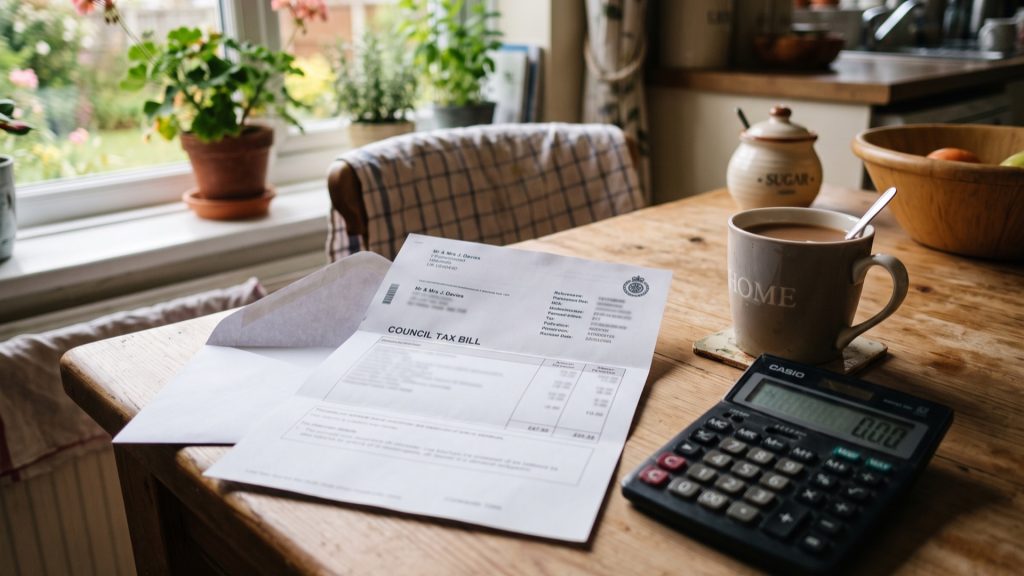
Dorset has the highest council tax bill of any local authority in England for 2026/27, according to figures published by the government.
A Band D household there is now paying £2,765.02 a year, up £134.72 on the year before.
That is more than double the cheapest bill in the country, and it isn’t even close.
It’s also a reminder of just how differently the same government service gets priced depending on which side of a council boundary your front door happens to sit.
So which areas made the top 10?
The figures come from GOV.UK’s “Council tax levels set by local authorities in England 2026 to 2027” release, published 25 March 2026. All figures below are for Band D, the standard measure used to compare areas.
| Rank | Local authority | Band D council tax |
|---|---|---|
| 1 | Dorset | £2,765.02 |
| 2 | Lewes | £2,756.17 |
| 3 | Nottingham | £2,755.39 |
| 4 | Wealden | £2,728.43 |
| 5 | Gateshead | £2,715.81 |
| 6 | Bristol | £2,713.68 |
| 7 | West Devon | £2,705.33 |
| 8 | Rother | £2,700.95 |
| 9 | Newark and Sherwood | £2,682.10 |
| 10 | Oxford | £2,678.40 |
Liverpool just misses the table in 11th place, at £2,673.59.
Notice how spread out these areas are. This isn’t a north-south story, or a rural-versus-city one.
Dorset, Nottingham, Bristol and Gateshead have very little in common except a big bill.
Some of these areas are rural, with fewer people to spread fixed running costs like adult social care across. Others are cities with high demand on those same services.
Either way, the bill lands the same: it’s one of the biggest they’ll pay all year.


Why is there such a huge gap with London?
Here’s where it gets a bit mad. Some of the cheapest council tax in the entire country is charged in some of the most expensive places to actually live.
The same GOV.UK release, 25 March 2026, Band D, shows the nine cheapest areas in England, and every single one is a London borough.
| Rank | Local authority | Band D council tax |
|---|---|---|
| 1 | Wandsworth | £1,028.21 |
| 2 | Westminster | £1,049.55 |
| 3 | City of London | £1,329.56 |
| 4 | Hammersmith and Fulham | £1,519.51 |
| 5 | Kensington and Chelsea | £1,666.65 |
| 6 | Tower Hamlets | £1,837.78 |
| 7 | Newham | £1,944.23 |
| 8 | Windsor and Maidenhead | £1,952.62 |
| 9 | Southwark | £1,967.26 |
We’ve stopped at nine because the tenth-cheapest spot isn’t clearly confirmed in the published data. Nine verified is better than a guessed tenth.
Wandsworth’s bill is £1,028.21. Dorset’s is £2,765.02.
That’s a gap of £1,736.81, over 168%, for the same Band D property between two parts of the same country.
The reason isn’t that London councils are cheap to run. It’s that council tax bands were set using 1991 property values, and London property has risen so much since then that a lot of homes sit in bands that no longer reflect what they’re actually worth.
A multi-million pound townhouse can still sit in a band that was set decades ago, back when its price would have looked absurd. Meanwhile a modest family home in Dorset gets billed at full whack against today’s rates.
It’s a quirk of the system, not a reward for living somewhere well run.
What's driving council tax up everywhere?
Zoom out and the average Band D bill across England is now £2,392, up £111 on last year, a rise of 4.9%.
That’s actually the smallest annual increase in three years, so the pace of rises has slowed slightly, even if bills keep climbing.
Councils are capped at a 5% increase without triggering a local referendum, which is why most bills move in a fairly tight band year on year.
A big chunk of that rise goes on adult social care, which has become one of the largest and fastest-growing costs any council carries. That’s a big part of why bills in rural and semi-rural areas, with older populations, tend to sit higher up the table.
Wales, which publishes its own separate figures, has a higher average of £2,283, up 5.2% on the year, so this isn’t just an England story either.
What can you actually do about your council tax bill?
Start by checking your band. It’s a two-minute job on the Valuation Office Agency website, and bands were set in 1991, so mistakes do exist.
If your property looks out of line with similar homes on your street, you can formally challenge the band. Just be aware a review can, in rare cases, move a band up as well as down, so it’s worth checking neighbouring properties first.
If you’re struggling to pay, contact your council directly. Many run a Council Tax Reduction scheme, and some offer discretionary hardship support for people on low incomes.
Single occupants are entitled to a 25% discount automatically, and it’s a claim a lot of people forget to make after a partner moves out or a housemate leaves.
Wherever you live, it’s worth setting your council tax aside as a fixed monthly cost rather than letting it catch you out each spring when the new rate lands.
If you found this interesting, please share!
Disclaimer: Content on this page is for informational purposes and does not constitute financial advice. Always do your own research before making a financially related decision.