Most people have no idea how much money they need to retire.
They just keep working and hoping it’ll somehow be enough.
Here’s a simple calculation that gives you an actual number.
Not a guess. Not a vague “as much as possible.”
A real target you can work towards.
It’s called the Rule of 25. And it changes everything once you understand it.
This post contains illustrative examples and is not financial advice. Capital is at risk when you invest.
Best ISA

Trading 212
Commission-free shares and ETFs in an ISA, Invest account or SIPP
Offer: Free fractional shares worth up to £100 with promo code GAINS (code must be used within 10 days of registering; value is random, most awards £8 to £25). Capital at risk, T&Cs apply.
- Commission-free trading, no account fee
- Pays interest on uninvested cash
- Stocks ISA and SIPP in one app
- No Junior ISA or Lifetime ISA
- 0.15% FX fee on non-GBP trades
- Fewer research tools than older platforms
- £1
- minimum
- Free
- platform fee
- Free
- trading fee
- 0.15% FX fee on non-GBP trades
Affiliate link. Capital at risk.
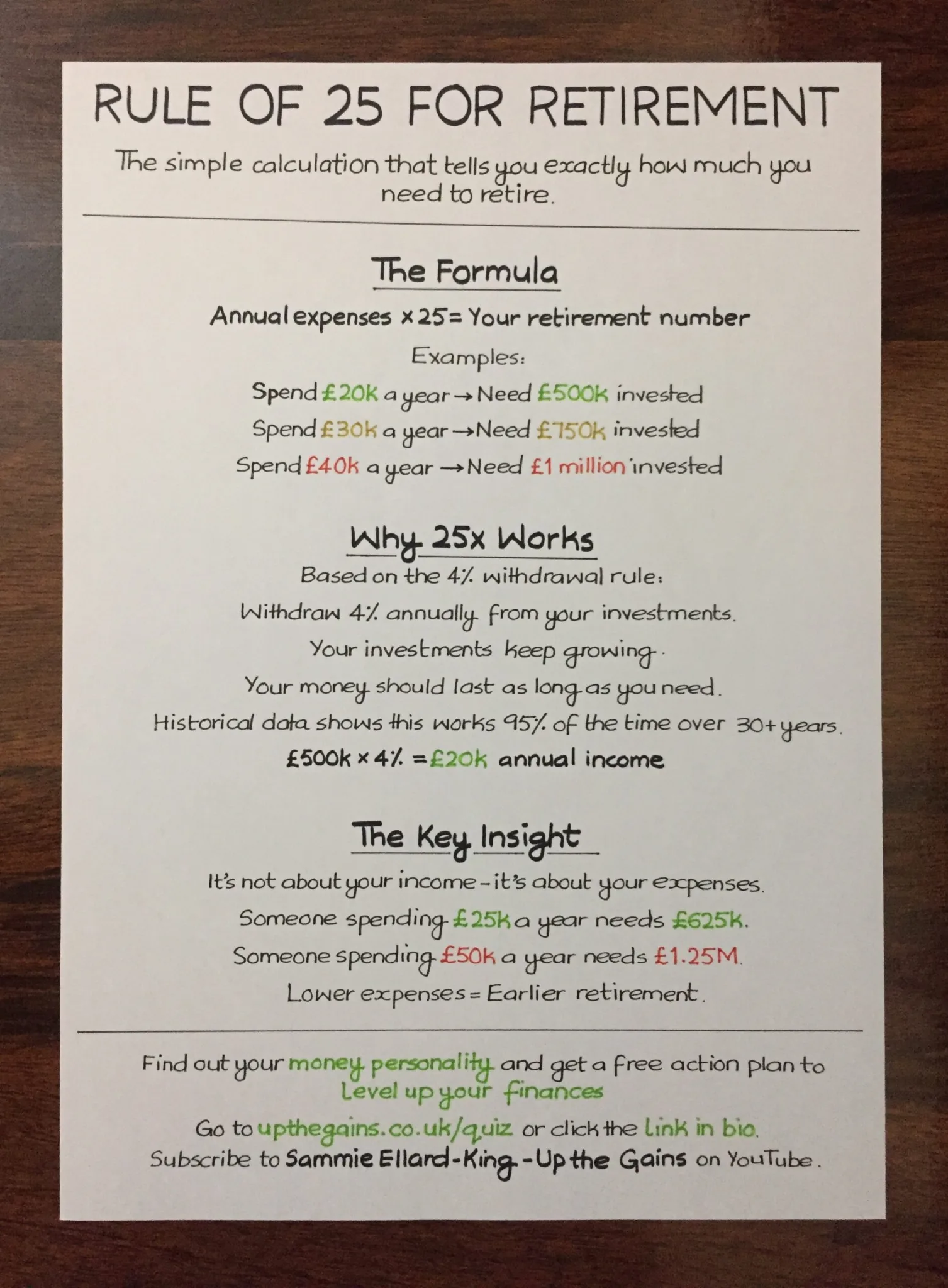
The Formula
Annual expenses × 25 = Your retirement number
That’s it. That’s the whole calculation.
Real Examples
Spend £20,000 per year: Need £500,000 invested.
Spend £30,000 per year: Need £750,000 invested.
Spend £40,000 per year: Need £1,000,000 invested.
Spend £50,000 per year: Need £1,250,000 invested.
See how this works? Whatever you spend annually, multiply by 25. That’s your retirement target.
Why 25x Works
This isn’t random. It’s based on decades of research into retirement withdrawal rates.
The magic number is 4%.
The 4% Withdrawal Rule
Take 4% of your pot in your first year of retirement, then increase that amount with inflation each year. Do that and, based on past market data, your money has usually lasted at least 30 years.
Why? Because your investments keep growing whilst you withdraw.
US data from 1926 onwards (the 1998 Trinity study) shows it worked in around 95% or more of 30-year periods for portfolios with at least half in shares, but past performance isn’t a guide to the future. Even accounting for market crashes, inflation, and bad timing.
The Maths
£500,000 invested × 4% = £20,000 per year.
You withdraw £20,000. But your £500,000 keeps growing. On average, it grows more than 4% per year.
Some years it grows 10%. Some years it drops 5%. Over the long run, a mix of global shares has historically averaged something like 5% to 8% a year, but growth isn’t guaranteed.
You’re taking out 4%. If it grows faster than that on average, the gap means your money shouldn’t run out.
In fact, your portfolio often ends up bigger than when you started. Even after decades of withdrawals.
Why Not 5% or 6%?
Higher withdrawal rates run out of money.
At 5%, the success rate drops sharply, and there’s a real chance you run out over a 30-year retirement.
At 6%, the risk climbs higher still, especially if markets fall early on.
At 4%, you have a 95% success rate. Those are odds you can actually retire on.
New to investing?
Get my free Checklist: the steps I would follow to open and fill an ISA without the classic mistakes. Plus one email a week, unsubscribe any time.
It’s About Expenses, Not Income
This is the key insight most people miss.
Your retirement number depends on what you spend, not what you earn.
Two Different People
Person A: Earns £60,000, spends £50,000. Needs £1,250,000 to retire.
Person B: Earns £40,000, spends £25,000. Needs £625,000 to retire.
Person B needs half as much, despite earning less. Lower expenses mean earlier retirement, every single time.
It’s also why lifestyle inflation wrecks retirement plans: you earn more, spend more, and your target keeps drifting further away.
Running Your Own Numbers
Don’t use my examples. Calculate your actual target.
Step 1: Work Out Your Annual Expenses
Add up everything you spend in a year. Rent or mortgage. Bills. Food. Transport. Insurance. Everything.
Be honest. Don’t use what you think you should spend. Use what you actually spend.
Track three months if you’re not sure. Multiply by 4. That’s your annual spending.
Step 2: Adjust For Retirement
Some expenses disappear in retirement. Commuting costs. Work clothes. Maybe you downsize and housing costs drop.
Some expenses might increase. More travel. More hobbies. Healthcare as you age.
Think about what your actual retirement spending will look like.
Step 3: Multiply By 25
Take that annual retirement spending figure. Multiply by 25.
That’s your number. That’s how much you need invested to retire.
Example Calculation
Current spending: £35,000 per year.
In retirement: No commute (-£2,000), no work clothes (-£500), more travel (+£3,000), mortgage paid off (-£8,000).
Retirement spending: £27,500 per year.
£27,500 × 25 = £687,500.
That’s the target. £687,500 invested. Then you can retire and withdraw £27,500 per year for decades.
What About State Pension?
The full new UK State Pension is currently about £12,500 per year (£241.30 a week for 2026/27).
You can subtract this from your needed income, which reduces your target.
Whatever you have to generate yourself will usually sit in a pension. I’ve compared the best pension providers on fees.
Adjusted Calculation
Need £30,000 per year to live.
State Pension provides £12,500.
You need to generate £17,500 from investments.
£17,500 × 25 = £437,500.
Your target drops from £750,000 to £437,500. Much more achievable.
The Catch
State Pension age keeps rising. It’s 66 now, moving to 67 between 2026 and 2028. It could reach 68 or higher eventually.
If you want to retire before State Pension age, you need the full amount. Can’t count on pension money you won’t receive yet.
 Read nextWhat is Coast FIRE? The UK Guide to Coasting to Retirement
How Long Does It Take?
Depends how much you save and how your investments grow.
Let’s run some scenarios. They assume 7% average growth a year, which isn’t guaranteed.
Saving £500 Per Month
At 7% average returns:
- 20 years: £262,000
- 25 years: £406,000
- 30 years: £607,000
If you need £500,000 to retire, you’re looking at about 27 years of consistent saving.
Saving £1,000 Per Month
At 7% average returns:
- 15 years: £319,000
- 20 years: £524,000
- 25 years: £812,000
If you need £500,000, you hit it in about 19 years. Need £750,000? About 24 years.
Saving £1,500 Per Month
At 7% average returns:
- 15 years: £479,000
- 18 years: £645,000
- 20 years: £786,000
Need £500,000? About 15 years. Need £750,000? About 19 years.
The Two Levers You Control
You can’t control investment returns. Markets do what they do.
You control two things: how much you save and how much you spend.
Lever 1: Save More
Every extra £100 per month invested accelerates your timeline.
Going from £500 to £600 per month saves you about 2 years. From £1,000 to £1,200 saves about 18 months.
More money invested means faster compounding means earlier retirement.
Lever 2: Spend Less
This is more powerful than most people realise.
If you need £40,000 per year, your target is £1,000,000.
Cut spending to £35,000 per year? Target drops to £875,000. You just removed £125,000 from your goal, probably 3-5 years of saving you no longer need to do.
Cut to £30,000 per year? Target is £750,000. You’ve removed £250,000.
Every pound you cut from annual spending removes £25 from your target. So cutting £100 a month (£1,200 a year) wipes £30,000 off it.
The 4% Rule Assumes You Stop Working Completely
What if you don’t?
What if retirement means working part-time doing something you enjoy? Or consulting a few hours a week? Or monetising a hobby?
Even £5,000-10,000 per year of income dramatically changes the maths.
Semi-Retirement Numbers
Need £30,000 per year. Earn £10,000 from part-time work.
You only need to generate £20,000 from investments.
£20,000 × 25 = £500,000.
Your target just dropped from £750,000 to £500,000. That’s potentially 5-7 years earlier you can “retire.”
Many people do this. Semi-retire in their 50s. Work part-time at something enjoyable. Supplement with investment income.
Much more achievable than full retirement at 40.
Not sure where to start?
Pick your goal (debt free, start investing, side income, saving for something big) and get a free money plan you can level up on. Takes about two minutes.
Get your free money planWhat About Different Withdrawal Rates?
The 4% rule (25x expenses) is conservative. It’s designed to last 30+ years with 95% success rate.
Some people use different rates depending on circumstances.
3.5% Rule (28.6x expenses)
Even more conservative. Better for very early retirement (retiring at 40 means money needs to last 50+ years).
Need £30,000 per year? Target is £858,000 instead of £750,000.
Safer. But requires more saving.
4.5% Rule (22.2x expenses)
Slightly more aggressive. Fine if you’re retiring later (60+) and don’t need money to last as long.
Need £30,000 per year? Target is £667,000 instead of £750,000.
Riskier. But gets you there faster.
Most people should stick with 4% rule. It’s the sweet spot between safety and achievability.
Geographic Arbitrage
The Rule of 25 gets more interesting if you’re willing to move.
£30,000 per year is tight in London. It’s comfortable in Portugal or Thailand.
Some people save in high-income countries, then retire in low-cost ones. Their money goes 2-3x further.
Not for everyone. But worth considering if you’re flexible about location.
The Psychological Shift
Once you know your number, everything changes. “Work forever” becomes “I need £687,500 invested”: concrete, trackable, and far more motivating than vague “save as much as possible” advice.
Every month you watch the pot grow, and you know exactly how close you are.
Common Questions
What about inflation?
The 4% rule accounts for inflation. Your withdrawals increase with inflation each year. The research assumed this.
What if markets crash right when I retire?
Bad timing. This is the main risk. Solutions: retire with slightly more than 25x, have 1-2 years expenses in cash so you’re not selling during crashes, be flexible with withdrawal amounts.
What about healthcare costs?
In the UK, NHS covers most healthcare. Private insurance is £50-150 per month. Factor this into your expense calculation.
Can I count my house?
Only if you plan to sell it and downsize. Your primary residence doesn’t generate income unless you access equity through downsizing or equity release.
Your Action Steps
Calculate your annual expenses. Be honest about the number.
Multiply by 25. That’s your retirement number. Write it down.
Calculate how much you’re currently saving per month towards retirement.
Use a compound interest calculator to see when you’ll hit your target.
For a real example of what consistency looks like, Ryan King’s £180,000 portfolio shows how much of the result comes from just staying the course.
Too long? Increase saving or decrease spending.
Track progress quarterly. Update your plan as life changes.
The Bottom Line
Retirement isn’t mysterious. It’s maths.
Annual expenses × 25 = retirement number.
Save until you hit that number. Withdraw 4% annually. Your money should last 30 years or more (probably).
Not complicated. Just requires consistency over decades.
The earlier you start, the easier it is. Compound growth does most of the heavy lifting if you give it enough time.
Someone starting at 25 can retire at 45 with moderate saving. Someone starting at 45 can retire at 65 with aggressive saving.
Both work. Earlier is just easier.
Your retirement number is waiting. Calculate it. Track towards it. Make it happen.
That’s all retirement planning really is.
If you want to hear real people talk through how they actually got there, these five pension podcast episodes are worth a listen.
If you found this interesting, please share!
Disclaimer: Content on this page is for informational purposes and does not constitute financial advice. Always do your own research before making a financially related decision.