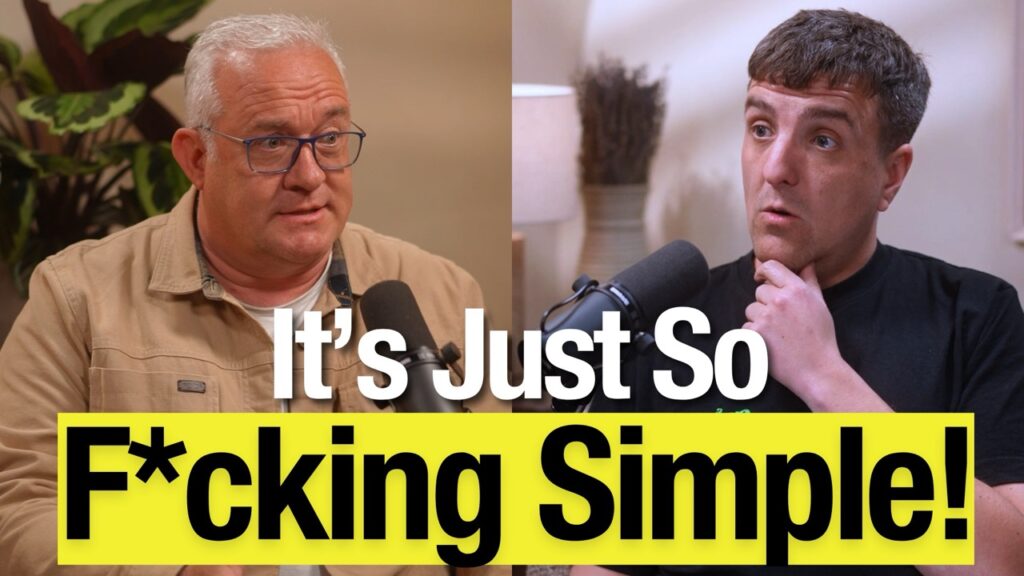

If Michael Taylor had £10,000 to invest today, he wouldn’t put it all in the FTSE 100 or the S&P 500. He’d rather spread it across the FTSE All World, and he says lump sum investing beats drip-feeding your money in 67% of the time.
In this Money Moment, I put trader and Shifting Shares founder Michael Taylor on the spot: FTSE 100 or S&P 500, which one do you back with £10,000?
His answer wasn’t what I expected. We ended up talking about why the S&P 500 is more concentrated than it looks, why he still trades UK stocks despite that, and why ASOS might not survive much longer.
Then we got into the question I get in my DMs constantly: if you’ve just come into some money, do you put it all in at once or drip it in over time? Michael’s answer comes down to maths versus your own head.
———
Gains App is LIVE!
An AI-powered budgeting and cashback app designed to help you make more of your money.
Download here: https://gainsapp.onelink.me/8IhT/oiaimr1z
———
Get a FREE FRACTIONAL SHARE worth up £100 when you deposit £1 with Trading 212
https://www.trading212.com/join/MGP
If you don’t receive the free fractional share, head to the menu and put the word ‘MGP’ into the promo code section.
(Capital at risk when you invest)
We’re delighted to welcome TIDE as a sponsor for the show.
Get £100 cashback when you deposit £5,000 within 30 days (T&Cs apply): https://www.tide.co/offers/gains/
Key takeaways
- Michael would rather hold FTSE All World than pick a side between FTSE 100 and S&P 500, because the S&P 500 is more concentrated in a handful of mega-cap tech stocks than it looks.
- The FTSE 100 leans on slower-growth “old economy” names like HSBC, Vodafone and Shell, while a third of the S&P 500 sits in the Magnificent 7.
- Lump sum investing beats pound-cost averaging roughly 67% of the time on the numbers, but Michael says the right choice depends on whether you can emotionally handle watching it drop.
- UK stocks have produced strong 10-baggers (Games Workshop, JD Sports, Domino’s), though Michael explains why he personally avoids ASOS as a business model he doesn’t think can compete with Shein.
- Michael’s own 2017 near-burnout, watching a portfolio bleed value daily after the general election, taught him why cutting losses is a lesson you have to learn the hard way.
Timestamps
- [00:19] FTSE 100 or S&P 500: the £10,000 question
- [02:17] US or UK: why Michael trades UK stocks
- [03:10] UK’s hidden 10-baggers, and why ASOS worries him
- [05:49] Lump sum or pound-cost average a windfall?
- [06:19] The 67% stat, and why it’s not the whole answer
- [09:47] Michael’s 2017 story: watching a portfolio bleed daily
- [11:34] Trading timeframes, and the case for just buying ETFs
FTSE 100 vs S&P 500: why Michael says "neither"
Asked to choose between the FTSE 100 and the S&P 500 for a £10,000 lump sum, Michael didn’t pick either.
His reasoning: the FTSE 100 is full of slower-growth “old economy” companies like HSBC, Vodafone and Shell, but the S&P 500 is riskier than its diversified reputation suggests.
A third of it sits in the Magnificent 7, which drove over half of last year’s gains.
Add tariffs and political risk under Trump, and Michael calls it “quite a heavy bet”. If he wasn’t managing his own money, he’d hold a broad global tracker instead, accepting it’s still roughly 70% US exposure but with more diversification if America underperforms.
That’s the kind of approach we cover in our guide to Index Funds UK.
For anyone weighing up the index side of that bet specifically, our guide to the FTSE 100 breaks down its biggest sectors.
Why UK stocks still have an edge (and one he avoids)
Pushed on US versus UK, Michael was clear he trades UK stocks exclusively, citing his knowledge of the market and direct access to management teams.
He pointed to Schroders research showing 10-baggers, stocks that grow tenfold, outperform in the UK. Games Workshop, JD Sports and Domino’s have all delivered for patient investors, part of why our guide to how to Pick A Stock doesn’t write off the UK market entirely.
ASOS was the exception: Michael thinks it has around 18 months before it needs refinancing again, unable to compete with Shein’s cheaper, duty-avoiding model.
Lump sum vs pound-cost averaging: the maths and the mindset
This is the question Michael and I both get flooded with in our DMs: if you’ve come into £10,000 or £50,000, do you invest it all at once or spread it out monthly?
Statistically, lump sum investing wins 67% of the time, because markets tend to rise over time. But Michael’s real answer is about temperament, not spreadsheets.
If a lump sum could drop 50% in a crash and you’d panic-sell and never return, the statistical edge is worthless.
For anyone weighing this up for the first time, our guide to Investing For Beginners covers the basics before you decide which approach suits your own risk tolerance.
Whichever route you pick, running the numbers through our Compound Interest Calculator shows how much time in the market matters more than timing it perfectly.
Michael's 2017 wake-up call
Michael went full-time trading in 2016, a bull market where “all you had to do was be long”. Then the 2017 general election hit liquidity, and he couldn’t exit positions without moving the price.
He described the stress physically: disrupted sleep, tension in his chest and shoulders, arguments with his wife. He eventually liquidated everything, still up overall, but the experience reshaped how seriously he now treats risk management and position sizing.
It was not the only close call in his career either: on his first Money Gains appearance he told the story of a holding being suspended for accounting fraud.
How Michael actually trades, and why he still says buy ETFs
Michael’s own positions back then were swing trades held for weeks or months, not day trades, though some of his trades now last only seconds.
He’s candid that intraday trading is “the hardest money you’ll ever make” and admits he isn’t especially good at it himself.
His preference is a longer time frame: get on board a trend and ride it up without watching the screen all day, which he says gives a higher strike rate and less stress.
His overall verdict for most people listening is blunt: most people shouldn’t trade at all, and are better off just buying ETFs.
This transcript is auto-generated and lightly edited for readability, it may contain errors.
[0:19] Sammie: If you had ten thousand pounds and you could choose where you had to invest it, but you had to invest it today, and you have two choices, the FTSE 100 or the S&P 500.
[0:30] Michael: Neither. Ooh. Because if you think you’ve if you have the FTSE 100, you were investing in dollar earners. They’re quite slow growth companies. I mean, we’ve got HSBC, Vodafone, Shell, sort of old economy companies. And then the S&P 500, one-third of that is the Magnificent 7. It drove over half of the gains last year. So yes, it looks like an ETF and it looks diversified, but actually it’s really concentrated. So now with Trump, you’ve got extra political risk, you’ve got tariffs. I just think it’s quite a heavy bet. Now, historically, that’s been great. In the last 10 years, S&P 500 has done fantastically well. There’s a reason it’s 70% of global ETFs, pretty much, because it’s so dominant. But if I was not to manage my own money, I would go with FTSE All World. And yes, that’s still going to be 70% of US is still going to be 70%, but you’ve got extra diversification. And then if the US does underperform, then at least you’ve still got exposure elsewhere. Now you could do FTSE All World excluding US, but then you were taking a view that, and the whole point of doing ETFs is to be passive, right? So yeah, I personally would do FTSE All World if I didn’t manage my own money.
[1:55] Sammie: That wasn’t a selection. You had FTSE 100 or S&P 500. Where are you going? Could you neither? You’d keep it in cash.
[2:02] Michael: I would do neither, yeah. Really? Um because well, I think S&P 500 is better than the FTSE 100, just because you got tech and everything. Yeah, yeah. But I I would choose neither. Yeah, I wouldn’t do I wouldn’t do one or the other. I would do a selection of of all of them.
[2:17] Sammie: So if I rephrase that question slightly then and I say US or UK, where would you go then? Because you’re a trader, that means it opens the floor up to multitude of different investments.
[2:28] Michael: So so I trade UK stocks. I only trade UK stocks. Uh that’s where my edge is. I know the market pretty well. I know the infrastructure. I know a lot of the businesses, speak to management teams regularly. So for me, I would always be UK biased, but again, I’m a trader. That said, uh 10 baggers outperform in the UK, according to Schroders research. So if you can actually find really good companies and you back yourself, you can do really well. And the odds of success are actually higher in the UK. But if if you’re talking just indices, S&P 500 is a way better index than FTSE 100.
[3:07] Sammie: Yeah, yeah, yeah. They’re slow old companies in the FTSE, aren’t they?
[3:10] Michael: Yeah. When you say 10 bagger, what do you mean when you say Yeah, so a stock that goes up ten times from its original investment price? Oh, nice. Um, so there’s been some fantastic winners in the London Stock Exchange. Uh Games Workshop is one that you wouldn’t otherwise think, but that has been a fantastic performer. Uh JD Sports, Domino’s, ASOS, definitely not a stock I would buy now. No.
[3:36] Sammie: Um I saw your video on that.
[3:37] Michael: Yeah, I mean, I think that’s gonna go bust.
[3:39] Sammie: Um really ASOS going bust.
[3:42] Michael: I I think it’s got two, well, it’s got 18 months now, because six months ago it refinanced into junk bond territory, free to a load of capital to reinvest, but it’s yeah, I just can’t see that business model working. You’ve got Shein, which doesn’t have the same you know, style and ethics as UK businesses, they can just fill it cheap, they avoid the import duty. Uh, there’s import VAT as well, I think they can get around. Uh, so it is just a way cheaper business model, and I don’t think ASOS can compete. And Pretty Little Thing have tried to rebrand it’s the same old stuff just with a makeover. I don’t see that working. Um, but yeah, in terms of the UK, there are some fantastic stocks, but there’s also a lot of dogs.
[4:29] Sammie: Yeah, there is, there is a lot. So, ASOS, then you reckon 18 months and it could be gone or then.
[4:36] Michael: It will need refinancing, I think. Now, there’s always people who are willing to refinance. I mean, TGI Friday’s went bust, someone bought it out. I don’t know why you would ever buy that business out because it looks the same as it did 20 years ago. It’s microwave slop, it’s awful. Um, but you know, peep people will buy anything if they think they can make a bit of money. Uh, and maybe they can, good luck to them. But yeah, that I thought that would be gone.
[5:03] Sammie: I had my first date in TGI Fridays. Think I was 13. Well, clearly not because we’re not together anymore, but I think we lasted two weeks. Um probably because it’s a good end. But I yeah, it is weird about TGIs because like back in the day it was a thing though, like you would go there, like your family would go there. Yeah, yeah, like you’d go to the cinema and it’s always next to the cinema. So you’d like go and have like a pre-hot dog there or a burger, and then you’d go to the cinema and fill up on sugar basically. Um, but yeah, no, it’s definitely gone downhill, it’s deserted.
[5:41] Michael: Well, I’m I’m from Hartlepool, we didn’t have TGIs, it was too classy, so uh yeah. That’s what I don’t remember.
[5:49] Sammie: I love that, but I want to sort of go back to the indices conversation because we both get a question a lot in our DMs, and I saw you post a story about it, and I think it was a really good uh kind of conversational point for today was let’s say, for example, you are investing into funds right now, yeah, and um or you’re thinking of investing into funds, and I get this question like I’ve just come into some money, I’ve got 10 grand or I’ve got 50 grand. What do I do? Do I lump some or do I dollar cost average, so putting the money in each month?
[6:19] Michael: Right. Well, the answer to that depends on do you want statistically better or do you want what’s better emotionally? Because statistically, lump sum is better 67% of the time. There’s been research. 67. Yeah. Um, obviously, you can tweak the data to manipulate it, but in general, that’s because markets go up over time. So if you put a lump sum in and markets generally go up, it’s gonna be better. Now, you could put you know a lump sum in today, market collapses in a month, 50%, which which it has done, 2007 GFC, uh things things take a bath. If you do your dough and then pull it out, and then you avoid the market forever, it doesn’t really matter if it’s statistically better because you’re not going to be in it and you’re not gonna profit. So if you can’t really accept that, and the thing is with volatility, everyone likes it when things are going up, it’s when it’s going down that they don’t like it. So if you think it might be better to just work your way in, then do that. And yes, statistically it might not be as good, but it might be better for you. Yeah. So there’s no one size fits all question. Uh it’s really down to your emotions, I guess.
[7:36] Sammie: Totally, ma’am. Like, we had it even uh like the correction, recent correction, and a lot of people messaging me like, Oh, I came into some money and I put it in, and like I’ve lost, I’m down two grand now, and like I’m freaking out, what do I do? And I was like, you know, you’re just gonna have to well you wait it out because that’s what you were gonna do anyway. Yeah, you know, so like you know, if it was going up, you weren’t gonna touch it. So it’s just the it’s just the inverse of that now.
[8:01] Michael: Yeah, pretty much, yeah.
[8:02] Sammie: And I always say to people, like, if that is you, like if you’ve never invested before, and you’re starting with that, and that is your first thing you do, that is a bad idea, just because you don’t know about yourself until you go through that moment, right? Like, and you see that 10%, 20% drop, and then suddenly you’re like, I’m finding out a lot about myself. Because for me, the first time it happened to me, I was like, gut wrench.
[8:28] Michael: Yeah.
[8:28] Sammie: Now I’m like, but like this is there’s a different because I’ve been through it. So if you never experienced it, you don’t know that about yourself, right?
[8:36] Michael: Yeah. That’s it. Everyone, when they start trading, they love volatility and they’re happy to pile in, and then when you lose a big chunk of money, you either learn or you burn out and you don’t come back. Um, but you have to go through that process because it’s okay for me to say, I’ll cut your losses, and everyone knows you need to cut your losses in trading. It obviously is different from investing, you’re probably gonna average down in investing, it’s two completely different things. Um, but you can say cut your losses. Everyone listens and then they never do, and then you find out, uh, and that’s that’s when you learn to cut your losses.
[9:10] Sammie: Oh mate, it’s so funny you said that because like I’ve said a hundred times that I’m like, okay, this is what I’m gonna do, this is what I’m gonna do, and then you get in you get into it first off, and you like start picking loads of things, you’re like, Yeah, and it will go up, and you’re like, I’m Warren Buffett, reincarnated, and then you’re like, no, a big slap round the chops, and you’re like, uh okay, yeah, I like I realise I’m not now, and I probably need to actually uh rethink what I’m doing. Um, and that’s when you find out really, because you you can do every survey, every risk assessment in the world, and it will tell you if you like high risk or if you like low risk until you go for it, you have no idea.
[9:47] Michael: Yeah, yeah. I mean that happened to me. Um, so I I got started, so I went full-time in 2016. Uh, it was a bull market, so it was very easy to make money. So again, I thought I was a good trader. I wasn’t, the market was going up, so all you had to do was be long. It was basically like 2020, 2021. If you bought stocks, you made money.
[10:07] Sammie: Yeah.
[10:07] Michael: Um, sadly, it’s not like that now. Um, but then we had the general election in 2017, and liquidity just evaporated, and a lot of things I couldn’t really sell without moving the price, and so therefore I just chose not to sell. Other people sold, and I was just watching the money go down. And honestly, it was so stressful, like it affected my sleep, like my chest and my shoulders were really heavy. I started having arguments with my wife um just because I was in such a foul mood. Um, and then when the closing bell would go, I’d I’d feel like relief because I wasn’t going to lose money until like 8 a.m. the next day. Um, but yeah, those those experiences you sort of realise um is it is it worth continuing? And eventually I just liquidated everything. Did you? Um, it was like just awful losses. But I was I was still up from where I started. Yeah, yeah. So that was the realization that I thought, well, if you actually learn how to do this properly, then you can continue to do it. Um, but as I say, I was I was tremendously lucky because it was a bull market when I got started.
[11:14] Sammie: And you’re like, that’s the psychology of a trader where it’s like happening over a matter of days for you right. And I mean it’s still the same, obviously, if you’re like holding a fund, but yeah, it’s like this is you’re watching like shorter terms.
[11:28] Michael: So these were sort of longer term swing trade positions, but I was watching them go down like minute by minute, yeah.
[11:34] Sammie: And every trade is different. So what does a long-term swing trade look like for you?
[11:38] Michael: So like weeks or months, okay, yes, short term, very short term.
[11:42] Sammie: Yeah, I guess so. Yeah.
[11:43] Michael: I mean, some of my trades last seconds, so really, yeah.
[11:46] Sammie: Oh, that’s amazing, man. I I don’t have the balls. Fair play to you.
[11:49] Michael: Um it’s I always say intraday trading is like the hardest money you’ll ever make. Um, and I don’t really mind saying I’m just not that good at it. Um, I can do okay, but the easiest way to make money in trading is to have a longer time frame, you know, weeks or months. Um, because then if you can get on board a trend, you can just ride that trend up and you don’t need to be watching the screen all day. Um, so it’s a much higher strike rate, it’s less stressful, and you’ve got a higher chance of success. Um, but yeah, I think trading, most people shouldn’t do it. Uh, you’re better off just just buying ETFs, in my opinion.
[12:27] Sammie: When it comes to investing, choosing a stocks and shares ISA for me is one of the most important steps you can make. And it comes down to three things. What can I invest into? Are they trusted by their customers? And most importantly, how low are their fees? So after testing over 10 different providers, I have landed on Trading 212. They have an excellent mobile app with thousands of stocks and funds available, and they offer commission-free trading with zero platform fees. Plus, they’re fully FCA regulated and have FSCS protection up to the value of 85,000 pounds. And right now, they’re offering listeners of this podcast a free share worth up to 100 pounds when you deposit just one pound into your account. So if you’re looking for a low cost stocks and shares and want to start investing, it’s hard to look anywhere else other than Trading 212. Use the code MGP for money gains podcast to grab your free share today.
Frequently asked questions
Michael says lump sum investing beats pound-cost averaging around 67% of the time statistically, because markets generally rise over time.
But if watching a lump sum drop sharply would make you panic and sell everything, drip-feeding it in monthly may suit you better emotionally, even if it’s not the statistically optimal choice.
Michael argues it’s riskier than it looks: around a third of the S&P 500 is the Magnificent 7, which drove over half of last year’s gains.
He’d rather hold a FTSE All World fund, which is still roughly 70% US but spreads risk more broadly if American markets underperform.
On the episode he explains he avoids the stock because, in his view, the business model faces structural pressure from Shein’s cheaper cost base and the balance sheet carries refinancing risk.
That is his personal market opinion as a trader, shared for discussion, not a prediction or advice.
Michael says his edge comes from knowing the UK market well: the infrastructure, the businesses, and regular contact with management teams.
He also cites Schroders research showing 10-baggers, stocks up tenfold, outperform in the UK, though he agrees the S&P 500 is a stronger index overall.
After the 2017 general election, liquidity dried up and Michael couldn’t sell positions without moving the price, so he watched losses build daily. He described the stress affecting his sleep and relationships before eventually liquidating everything, still up overall from where he started.
———
This video is meant for educational purposes and should not be considered financial advice. When you invest your capital is at risk. Past performance is not a guarantee of future success.
This video description contains affiliate links – if you click on one and make a purchase we may receive a small commission. This does not alter our suggestions and there is no charge for you.