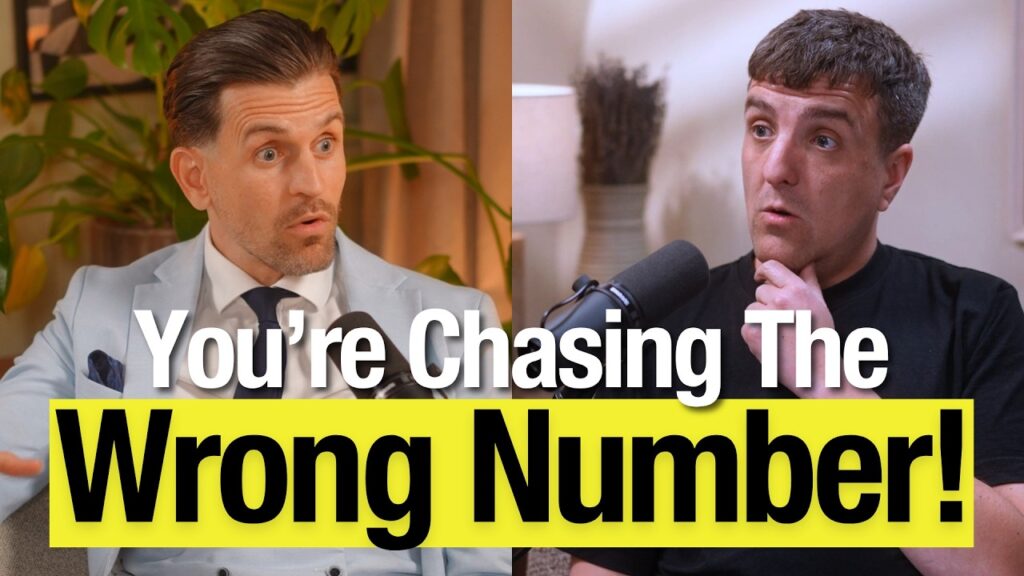

Andrew Craig has spent years trying to make Brits richer, and he says the country’s own economy keeps working against him.
In this Money Moment, he explains why UK GDP per capita has barely moved in thirty years, and why he thinks financial literacy is the only real way out.
I sat down with Andrew Craig, founder of Plain English Finance and author of “How to Own The World”, for a shorter Money Moments chat focused entirely on the state of Britain.
Andrew doesn’t usually talk politics. He talks money. But he makes the point that the two are impossible to separate when the numbers are this stark.
What follows isn’t a party-political rant.
It’s a look at what happens to ordinary people’s finances when a country’s growth stalls for decades, and why Andrew thinks the answer has nothing to do with who’s in Number 10 and everything to do with how financially literate we are as a population.
———
Gains App is LIVE!
An AI-powered budgeting and cashback app designed to help you make more of your money.
Download here: https://gainsapp.onelink.me/8IhT/oiaimr1z
———
Get a FREE FRACTIONAL SHARE worth up £100 when you deposit £1 with Trading 212
https://www.trading212.com/join/MGP
If you don’t receive the free fractional share, head to the menu and put the word ‘MGP’ into the promo code section.
(Capital at risk when you invest)
———
DISCLAIMER:
This video is meant for educational purposes and should not be considered financial advice. When you invest your capital is at risk. Past performance is not a guarantee of future success. Please be aware of the dangers of leveraged finances and do your own research accordingly.
This video description contains affiliate links – if you click on one and make a purchase we may receive a small commission. This does not alter our suggestions and there is no charge for you.
Key takeaways
- UK GDP per capita has sat around $45,000 to $46,000 for roughly three decades, while countries like Ireland, Singapore and the US have pulled well ahead.
- Andrew argues politicians repeatedly confuse “tax rate” with “tax take”, pointing to JFK, Reagan and George Osborne as examples of cuts that raised total revenue.
- Andrew estimates around 14.6 million British adults are economically stretched, and that gap will not close without a shift in financial literacy.
- His mission is aimed at the “millions in the middle”: people who aren’t wealthy but could be if they understood a few simple financial habits.
- Rising costs hit lower earners hardest, since essentials like food and energy take up a much bigger share of a tight budget.
Timestamps
- [0:18] Andrew Craig: The State of Britain Today
- [0:45] Tool: The Tax Rate vs Tax Take Lesson
- [4:09] Hospitality Industry Under Pressure
- [4:53] GDP Per Capita: Britain vs the World
- [9:02] Tool: Why Financial Literacy Is the Fix
- [10:34] John Major and Britain’s Political Class
Why UK GDP Per Capita Has Barely Moved in Thirty Years
Andrew’s central argument rests on one number: GDP per capita, roughly average income per person. He put it bluntly: “GDP per capita in Britain today is about 45,000, 46,000 US dollars per capita… which is roughly the same as what it was 30 years ago.”
That’s not a one-off dip. It’s three decades of standing still while other countries moved on. Andrew pointed to Ireland (“twice as rich as us per capita now”) and the US, where average incomes sit closer to $75,000 to $80,000.
He also flagged Singapore, Australia and South Korea as economies that have overtaken the UK, adding that Poland and the Czech Republic are catching up fast.
His explanation wasn’t luck. “Is that some strange… aliens from out of space just gifting them loads of no, it’s policy, yeah, it’s good policy.”
For anyone building their own wealth, that’s a reminder that where your money is invested matters. Plenty of UK savers only ever hold UK shares, when investing in index funds can spread that risk across the same global economies pulling ahead.
The Tax Rate vs Tax Take Lesson Politicians Keep Missing
Andrew’s specific frustration is a distinction he thinks gets lost in political debate: the difference between raising a tax rate and actually raising the money collected.
He cited a run of historical examples, from JFK cutting income tax in the 1960s to Reagan doing the same in the 1980s, and closer to home, George Osborne cutting corporation tax from 28% to 19% over a decade “we made billions more tax.”
He contrasted that with a period when income tax hit 50% and revenues fell, only recovering once the rate came back down to 45%.
His conclusion: “it’s really nuts to me that you can have a chancellor of the exchequer who doesn’t understand the difference between tax rate and tax take.”
Whatever your view on any specific budget, the underlying point for your own finances is straightforward: policy decisions ripple through to your take-home pay, the cost of your weekly shop and the returns on anything you hold.
Getting the basics of investing for beginners sorted gives you a buffer against decisions you have no control over.
Why a Struggling Economy Makes Financial Literacy Non-Negotiable
Andrew is careful to separate his politics from his mission. “I’ve never held myself out as somebody who speaks about politics… but you speak about financial matters, which is… it does bleed over to politics.”
He cited a survey suggesting roughly 14.6 million British adults are “really challenged economically”, and said that gap won’t close on its own.
His focus isn’t the wealthiest, who he estimates roughly matches the number of people with a stocks and shares ISA in the UK. It’s the “millions in the middle”: people who aren’t struggling but aren’t set up for the long term either.
His comparison countries back this up.
He put Singapore and Australia’s wealth down to strong pension systems and capital markets built up since the 1960s and 80s respectively, noting Singapore “was as poor as a sub-Saharan African country at the end of the Second World War” and is now more than twice as wealthy as the UK per person.
How to Protect Your Own Money When the Economy Isn't Helping
You can’t fix GDP per capita from your kitchen table, but Andrew’s whole career is built on the idea you can control your own outcome regardless.
Picking a reliable platform matters here too, and comparing investing apps is a sensible first step before you commit any money.
The compounding argument is the same one Andrew makes in his book: small, consistent contributions over a long horizon do more than any single decision about which government is in power.
If you want to see how that plays out over time, the compound interest calculator is a quick way to put real numbers against it.
This transcript is auto-generated and lightly edited for readability, it may contain errors.
[0:18] Sammie Ellard-King:
The way I’d love to steer this conversation is something that you’ve been talking about quite a lot recently, and that’s kind of very much on the UK.
[0:26] Andrew Craig:
The bad news. So our future is biologically. The world’s gonna be amazing, we’re all gonna be really wealthy and healthy and live for years. But the bad news is Britain is awful. Yeah, yeah.
[0:34] Sammie Ellard-King:
And how do you feel things have been going at the moment?
[0:37] Andrew Craig:
Well, it’s so uh uh sorry it sounds slightly pretentious thing to say, but I was honored to contribute my first guest article to the Telegraph last week.
[0:44] Sammie Ellard-King:
Nice, congrats.
[0:45] Andrew Craig:
Which is yeah, thank you. It was really cool, actually. It’s gone super viral, it’s had like 800 and something comments in three days. So it’s yeah, um, it it’s been a hit, and hopefully I’ll that means I’ll get to do a few more articles. But uh it was it was a pretty punchy um title to the article, which was something along the lines of Rachel Reeves’s economic um incompetence is mind-blowing, or something, which to be fair to me, the telegraph chose, um, and then they toned it down a bit. I can’t remember what it is now, but but on that point, I mean, I did a specific piece about you know, it just I find it absolutely bewildering that we have politicians, and to be clear, this isn’t party political. I mean, it kind of is de facto because they’re the Labour Party, but the Tories have been j awful as well, like just dreadful. The lack of economic literacy and the damage that’s wreaking in our country. But on that, specifically, because obviously catalyzed by the budget at the end of October, is like, how is it possible for anybody who’s been a student of economics in different countries and nation states for the last frankly century, but let’s just dwell on the last few decades, to think that what she’s just done with national insurance contributions is going to do anything. The only growth that that’s gonna engender will be in unemployment, insolvencies, and welfare costs. You know, higher unemployment, bigger welfare costs. And the proof’s already in the pudding in that, you know, like last month was the second highest borrowing month ever in history since record began from the government of 17.2 billion quid or whatever. September was not far below that. So, you know, already now the the the Labour Party is running, their borrowing levels are running way, way ahead of all the nonsense forecasts that they they spew out, or whoever, you know, whichever organization you’re talking about. And it’s just like, you know, in the 60s, JFK reduced income tax and tax receipts, like the amount of tax they got from people, went up massive. Yep. In the 80s, Ronald Reagan did the same thing. George Osborne um so Labour put the income tax rate up to 50% in the whenever it was, early noughties, late 90s. Tax revenues fell, and then George Osborne put it back from 50% to 45%, tax revenues went up. Corporation tax went from 28% to 19% over 10 years from sort of 2010 onwards. We made billions more tax. And this whole like it’s really nuts to me that you can have a chancellor of the exchequer who doesn’t understand the difference between tax rate and tax take. Because actually, what I always come back to with all of this stuff, genuinely, is what is the best possible outcome for the biggest number of people, right? When you’re making policy, what you want is is as many people as possible, live the best life possible. You know, you want your NHS, you want everything paid for. And if there’s like decades of evidence that what you’re doing is just completely wrong, and it’s going to engender a terrible outcome, like whatever your political persuasion, like don’t do it. And that’s actually I finished the article with saying um that the biggest irony about this, these, you know, what the government’s doing at the moment is that the people who will be harmed most without you know, factually, like you might look at me and think I’m a Tory, I’m not at all like I’ve I’ve taken, you know, I’m given up on all politicians in this country because they’re all so incompetent. But you know, it’s the it’s the least fortunate in society that bear the brunt of a cost of living crisis, right? Because if you know, if eggs and bread and milk and pasta and everything go through the roof and energy costs go through the roof, rich people, it’s annoying, but it’s not that big a deal. Exactly.
[4:08] Sammie Ellard-King:
They’re not going to stop shopping at Waitrose.
[4:09] Andrew Craig:
Yeah, exactly. Um, and or or or they can downsize to LD, you know, if it’s getting if it’s getting bad, exactly. You can do that in Fleet, where we both live. But um, but in all seriousness, it’s you know, that’s how I signed off that article. It’s like what I find so unbelievable is that the Labour Party was founded to represent working people and the least fortunate in our society. And it’s nuts that you’ve got a situation where anybody who’s vaguely economically literate will tell you that what they’ve just done is gonna be ruinous to millions of people. It’s gonna like 80% of pubs in Britain are now loss making. Yeah, I know. 80% of but like restaurant, every single hotel group in the country is coming out up in arms saying we’re screwed, you know, like the whole hospitality.
[4:50] Sammie Ellard-King:
But we raised beer tax by lost beer tax by one pence.
[4:53] Andrew Craig:
But how they can’t see that the net result of that is gonna be hundreds of thousands more people out of work. High streets, you know, tumbleweed high streets up and down the country, right? Of basically like because if you think about it, like in a really small uh high street, pubs are quite an important part of the community and the economy, right? You know, you’ve got a betting shop nowadays, you’ve got loads of charity shops and a betting shop and some hair hair barber shops or whatever, but the pub was the kind of epicentre of a lot of communities, particularly in rural communities. Definitely. So if a pub goes and your post office is gone and the bus route’s not going, you know, this this stuff, I mean, and yeah, I don’t want to go on. You’ve got me straight onto my high horse, but I just I find it so depressing at the moment because it’s like it’s just a no-brainer. All these decisions have been taken are so bad for Britain, and it’s just made, you know. I can’t remember if we talked about this last time, but you know, the the most and by the way, this is the Tories for because the Tories have been cocking it up for you know the previous 14 years anyway. But the but the for me, the most important metric that we you know, if you want to acknowledge there is a problem rather than this self-serving, am I allowed to swear on this one? Please do self-serving bullshit that no, it’s great and Britain’s really great, and we’re a tech superpower, it’s just complete bullshit, right? No, agreed. And the evidence, the the biggest evidentiary point is GDP per capita in Britain today is is about 45,000, 46,000 US dollars per capita, right? Sort of average incomes, which is roughly the same as what it was 30 years ago, yeah, right? We’ve been slowly creeping down that in real, and actually, if you take the richest 1% out, all the people who are leaving at the moment, by the way, which we can come back to perhaps, which does matter, no matter if you want to hate the rich and vilify the rich, you know, if if people who pay hundreds of billions of dollars and create all the the jobs leave to go to Dubai or whatever, that’s a serious problem for people who are left. But the point I wanted to make is that, you know, again, this is not I’m not like pulling these figures out of the um out of my proverbial, but like Ireland is twice as rich as us per capita now, depending on how how you account for purchasing power power parity. America’s just way wealthy, you know, like $75,000, $80,000 per capita instead of our 45.
[7:05] Sammie Ellard-King:
Yeah.
[7:05] Andrew Craig:
Singapore, Australia, South Korea, like Poland is going to be richer than us soon. The Czech Republic is going to be richer than us soon. It’s absolutely nuts, right? And Winston Churchill and the great founders of Empire must be turning their graves to see what we’re doing. And it’s and the real frustration to me is that it is and it’s funny because I’ve never held myself out as as a as somebody who speaks about politics. That’s not my that’s not my thing, right? But you speak about financial matters, which is and it does bleed over to politics because it’s sort of like like I guess my mission more than anything else, as I went back to, you know, the reason I’ve been so mission-driven about trying to improve the financial affairs and the financial literacy of as many people as possible is because I see it as a silver bullet for a better society. Absolutely. I mean, I yeah, we resonate with that, but like you know, you if you had a few million more people in Britain understand what’s in my book, you know, available on Amazon, etc. etc. nonsense. But you know, in all seriousness, if you have like there there’s there’s a stat um that was from a survey about a year ago that said something like 14.6 million British adults are really challenged economically, which is all part and part parcel of this, and it creates a long road back. And it’s and and we’re doing 180 degrees the wrong, the opposite of what we should be doing if we want to sort that out. Completely agree with that. And that number’s gonna get worse, but but and I and I the point I wanted to make is I think for a lot of those people, you know, there’s gonna have to be a really, really big sea change uh over 10 plus years to for for for that for them to be helped back into kind of being abundant and affluent and having a better life. Yeah. But that doesn’t change so my mission then is focused on let’s say there’s like five million fairly rich people in the country, you know, 50 million British adults, say 10% of them are actually pretty you know, not doing too badly and pretty well set up and fairly financially literate. And that corresponds roughly to the number of people who have stocks and shares ISA, which I always go back to. It’s actually a bit less than five million, but just call it that. My focus is the millions of people in the middle, because there are there are there are literally tens of millions of people in this country.
[9:00] Sammie Ellard-King:
Yeah, how do we slip start them slipping?
[9:02] Andrew Craig:
Well, no, but if they just have basic financial literacy and took a set of relatively simple steps that we have obviously talked about, and you’re an expert on, and you talk about and everything you do, stuff that’s kind of obvious to you, and it’s obvious to me, and I’ve written books about it and stuff, but it’s still not obvious to you, you know, it’s still information that most people aren’t conversant with. But but if if a few tens of millions more people understood this stuff and took it on board, the outcome for those people is life-changing. Yeah. And I and I can see it, it takes years. It does not you can’t just do something and the next year your life will be better. This is something that is a real slow burn, which is part of the problem, why it’s hard for people, you know, a lot of people can’t take that on board. But bigger picture, and I came looking at the wrong way around, but my broad point was going to be if you have many millions of people who do that, British society is much better. You know, why is Singapore so rich? Because they’ve all got massive pension funds. Why is Australia so rich? Why is Norway so rich? Because they’ve done an incredibly good job with their financial affairs and their capital markets for like since the 80s, and in Singapore’s case, since the 60s. The people in Singapore are more than twice as wealthy as we are. And by the way, Singapore was as poor as a sub-Saharan African country at the end of the Second World War. So was South Korea, so was Taiwan. Today they’re much, much richer than us. Now, is that some strange is that aliens from out of space just gifting them loads of no, it’s policy, yeah, it’s good policy, right? And that’s what makes me so angry, is we now have a political class going back to being political again. And as I say, I’m not party political. The Tories were an unmitigated disaster. I think Blair and Brown were an unmitigated disaster.
[10:34] Sammie Ellard-King:
I think probably John Major, I now sound like I’m a Tory, but well, he’s possibly the last stable prime minister, right?
[10:39] Andrew Craig:
The last true state I saw him present actually at an event in Wapping a few weeks ago, and he was unbelievably impressive.
[10:46] Sammie Ellard-King:
And just I still find him extremely impressive.
[10:49] Andrew Craig:
And I think he got about because I don’t know if you you might this sounds really patronising thing to say, but maybe you’re too young for spitting image. Do you remember spitting image? No. No, there you go. I was I was right. So it was this crazy comedy show with sort of rubber puppets. That was a huge hit in like the 80s, and they basically had a really, really they really had it in for um John Major and they made him into this that he was all painted grey and he’s like this.
[11:10] Sammie Ellard-King:
All right.
[11:10] Andrew Craig:
And so I think that kind of slightly torpedoed his screen. It’s a bit like um, do you ever watch Bo Selecta? Oh yeah. So um to what they’ve done to Craig David. Craig David, uh yeah, Craig David was not loving Bo Selecta, nor um Chris Martin, it’s a run-around running around with clocks going on, but yeah, go wow, it’s slightly going off piece there.
[11:28] Sammie Ellard-King:
But no, but it like I think what you’re trying to say is that like essentially they had a chance to in this budget, I think, to like rectify it, right? And that what they didn’t do is they went completely. I think for me it was like a PR-lauded win.
[11:44] Andrew Craig:
Yeah, yeah, yeah. There was a big so it everybody I know in the city, like senior city professionals are basically expecting what they thought was happening, which companies do a lot. So like when companies announce their results, that they kind of have all the financial analysts that write about them sort of bring their numbers down and so they can do a positive surprise, and then the share price reacts positively. And it’s this idea that you should always kind of underpromise and over-deliver, and then you get a disproportionately positive result from doing that, right? Um, because it’s all kind of you know, momentum and everything feel good and everything, and that sort of those animal spirits play into how the economy can function at the level of the economy rather than say a company. And and so the sense was that you know, there was all this nervousness about capital gains and inheritance tax, and blah, blah, blah. What was she gonna do? And it’s labor and it’s gonna be a disaster, it’s gonna destroy the economy. Yeah.
[12:34] Sammie Ellard-King:
Some of the WhatsApp chats were incredible.
[12:36] Andrew Craig:
100%. And but everybody kind of expected, now what’s actually gonna happen is she’s gonna stand up and it’s gonna be really quite sensible, and everyone’s going, okay, awesome. And there’ll be a big big relief rally, you know, the pound will go up, um, gilts will be steady, and like billions of pounds will flow into UK equities and off we go, and everything’s better again. And it wasn’t that, it was a complete catastrophe. And it’s like it’s just mind-blowing.
[13:04] Sammie Ellard-King:
Are you ready to take your first steps into investing? We’re thrilled to partner with Trading 212, the app that makes investing accessible and straightforward for everyone. With Trading 212, you can open a stocks and shares ISA that’s packed with features, zero commission on your investments, industry low FX fees, and access to thousands of ETF funds and individual stocks from markets all over the world. The app is incredibly intuitive, designed to help you invest with confidence. Whether you’re a total beginner or already a pro, Trading 212 is FCA regulated and the clients’ funds are protected by FSCS protection. Honestly, I am such a fan of how easy it is to use that I’ve started recommending it to friends who are new to investing themselves. It’s simple and secure, and it gives you all the tools you need to build your portfolio. And here’s the best part right now, Trading 212 is offering you guys a free fractional share worth up to £100 when you sign up and deposit just one pound. To grab this offer, head to the link in the show notes or use the code MGP when signing up. As always, remember your capital is at risk when investing. ISA rules and Ts and C’s and other fees may apply. So why wait? Start building your future with Trading 212 today. And now back to the episode.
Frequently asked questions
GDP per capita measures average economic output per person, which broadly tracks average income. Andrew uses it because it strips out population growth and shows whether living standards are genuinely improving.
He argues UK GDP per capita has been flat for around thirty years, which he sees as the clearest sign something structural is wrong.
No. Andrew was explicit that his criticism isn’t party political, saying he has “given up on all politicians in this country because they’re all so incompetent.” His argument targets specific tax and spending decisions rather than any single party.
Tax rate is the percentage charged. Tax take is the total revenue actually collected. Andrew argues that raising a rate too high can reduce total revenue, citing historical examples where cutting rates coincided with higher total tax collected, and vice versa.
He referenced a survey estimating around 14.6 million British adults are economically challenged, describing it as a long road back that requires a significant shift in financial literacy over time rather than a quick fix.
A country’s growth rate affects wages, prices and company profits, all of which feed into your own finances. Andrew’s point is that you can’t control national policy, but you can control how well diversified and financially literate you are, which matters more the weaker the wider economy performs. This article is for educational purposes only and should not be considered financial advice. When you invest, your capital is at risk and past performance is not a guarantee of future results. This article contains affiliate links; if you click through and make a purchase we may receive a small commission at no extra cost to you.
———