FIRE stands for Financial Independence, Retire Early. You save and invest hard now so your investments cover your living costs decades before the state pension age.
The standard target is 25 times your annual spending, invested and drawn down at 4% a year. Hit that number and work becomes optional.
This guide covers how FIRE actually works, the five types you can aim for, and how to start building towards it in the UK.
Table of Contents
What is the FIRE movement?
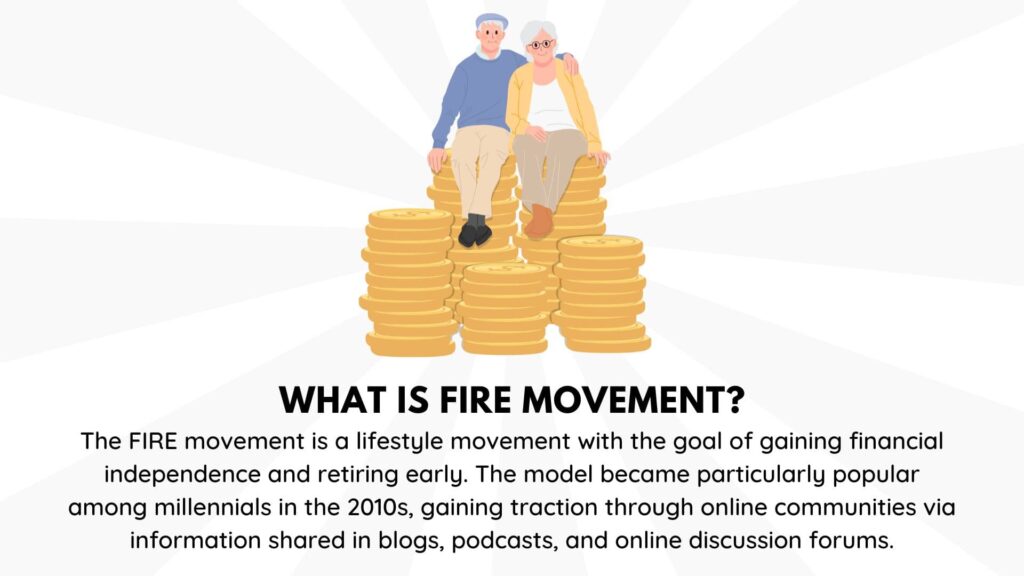
The phrase Financial Independence, Retire Early was coined in 1992 by Vicki Robin and Joe Dominguez in their book Your Money or Your Life. It has since grown into a global movement built on one idea: save aggressively, invest the surplus, and buy back your time.
The mechanics are simple. Followers aim for a savings rate of 30-60% of income (some push higher), put the surplus into low-cost index funds, and let compound growth do the rest. Once your invested pot can cover your annual spending, you are financially independent. Work becomes a choice, not a requirement.
FIRE has taken off in the UK largely through social media and podcasts, where people share real numbers and real timelines rather than vague retirement advice. Rising living costs have pushed more people to ask exactly how much they need and how fast they can get there, which is precisely the question FIRE answers.
How much do you need to retire early?
The maths is the 25x rule, also known as the 4% rule: multiply your annual spending by 25, and that is your FIRE number. Withdraw 4% of it each year and, historically, the pot should last indefinitely.
| Annual spending | FIRE number (25x) |
|---|---|
| £20,000 | £500,000 |
| £30,000 | £750,000 |
| £40,000 | £1,000,000 |
If you want more of a safety margin, some people use a 3.5% withdrawal rate instead, which pushes the target closer to 28-29x spending. It is more cautious, but it means saving longer.
Work out your own with our FIRE calculator.
The five types of FIRE
FIRE is not one-size-fits-all. Here is where each type sits, from most flexible to most demanding.
Coast FIRE means saving enough, early enough, that compound growth alone will get you to a full retirement pot by a normal retirement age, even if you stop contributing. You still work, but only to cover today’s living costs. Try our Coast FIRE calculator.
Barista FIRE is a step up: you have enough invested to cover most of your costs, then work part-time (the name comes from taking a job like a barista) to fill the gap and often to keep employer healthcare or benefits. Try our Barista FIRE calculator.
Lean FIRE means retiring on a minimal budget, often well under £25,000 a year. It needs a smaller pot but demands sustained frugality once you get there. Try our Lean FIRE calculator.
Fat FIRE is the opposite: you retire early without cutting your lifestyle, which means a much bigger pot and a higher income to fund it. Try our Fat FIRE calculator.
Traditional FIRE sits in the middle: hit 25x your current annual spending, retire, and live much as you do now.
| Type | Lifestyle | Pot size | Best for |
|---|---|---|---|
| Coast FIRE | Normal, keep working | Smallest (grows to full pot on its own) | Early savers who want less pressure |
| Barista FIRE | Normal, part-time work | Medium | Wanting freedom sooner, not fully retired |
| Traditional FIRE | Normal, fully retired | 25x spending | Anyone following the standard rule |
| Lean FIRE | Minimal | Smallest full-retirement pot | High savers, low spenders |
| Fat FIRE | Unchanged or better | Largest | High earners who don’t want to cut back |
How to start FIRE in the UK
- Know your number. Run the FIRE calculator with your real spending, not a guess.
- Clear expensive debt and build an emergency fund. Aim for 3-6 months of expenses before you push hard on investing.
- Push your savings rate. Start with a proper budget so you know where the surplus actually comes from. For help staying consistent, check out our own Gains App.
- Invest in index funds through an ISA and a pension. Pension contributions get tax relief and employer matching; ISAs give you tax-free access before pension age. With private pension access moving to 57 from 2028, your ISA is what bridges the years before that.
- Choose where the pension sits. I’ve compared the best pension providers on fees, which matter more over decades than most people expect.
- Grow your income. A side hustle increases your savings rate faster than cutting spending ever will.
Is the FIRE movement worth it?
The main criticism is fair: extreme frugality for a decade can cost you experiences in your 20s and 30s that you never get back. Markets don’t move in straight lines either, so a plan built on spreadsheet assumptions can wobble in the real world.
The counter is that FIRE is a spectrum, not a pass/fail test. Even saving half as aggressively as the most committed followers still leaves you years ahead of doing nothing. That is exactly why the five types exist: pick the intensity that matches your life, not someone else’s.
Worth it or not depends on what you are optimising for. If working until 67 sounds fine, you don’t need FIRE. If the idea of options in your 40s or 50s appeals, even a partial version of this plan is worth building. Neil Invests went from sleeping on his sister’s floor to being on track to retire at 50, proof that the maths works even from a standing start.
Final thoughts
You don’t need to pick a lane on day one. Run the numbers, see which type of FIRE fits your income and spending, and start building the habit of investing the difference.
Use the FIRE calculator to get your number, then come back to the guide for the type that matches how you actually want to live.
Frequently asked questions
FIRE stands for Financial Independence, Retire Early. It describes saving and investing aggressively so your investments can cover your living costs well before the usual retirement age.
The standard target is 25 times your annual spending, based on a 4% withdrawal rate. Someone spending £30,000 a year would need around £750,000 invested.
Coast FIRE, Barista FIRE, Traditional FIRE, Lean FIRE and Fat FIRE. They differ mainly in lifestyle and pot size, from Coast (still working, smallest pot needed) to Fat FIRE (fully retired, largest pot, no lifestyle cuts).
It depends on how much intensity you want. Full FIRE demands high savings rates and discipline, but even a partial approach, saving and investing more consistently, leaves most people far ahead of doing nothing.
Work out your FIRE number, clear expensive debt, build an emergency fund, then push your savings rate into index funds through an ISA and pension. Growing your income speeds up the whole process.
Yes, though the numbers are higher because household spending is higher. Many families use Barista or Coast FIRE rather than full FIRE, since it is less disruptive to childcare and income needs.
Not directly. Most FIRE plans target full independence before State Pension age, so the State Pension becomes a bonus on top of your invested pot rather than something you rely on to retire early.
Share on social media
Disclaimer: Content on this page is for informational purposes and does not constitute financial advice. Always do your own research before making a financially related decision.