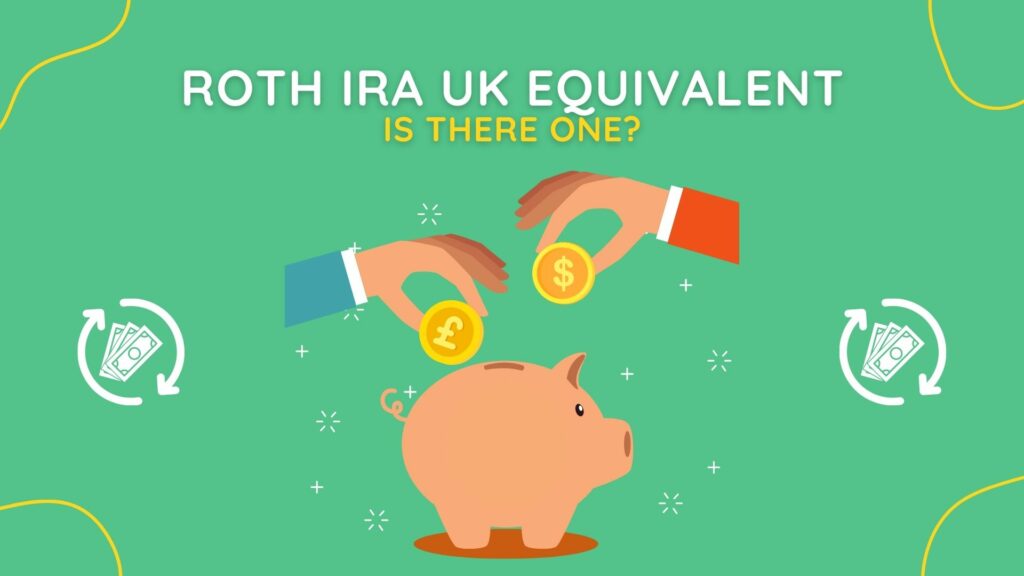
The short answer: the UK doesn’t have a Roth IRA.
The closest UK equivalent is the Stocks and Shares ISA.
The Lifetime ISA (LISA) is the second-closest match if you’re specifically saving for retirement.
Both let you invest after-tax money and take withdrawals tax-free, which is exactly what the Roth IRA does in the US.
Neither UK option is a perfect one-to-one swap. Contribution limits differ, access ages differ, and the Lifetime ISA has a 25% government bonus that no US account offers.
But for the core Roth IRA question, “where do I put money after tax so it grows tax-free for life”, the Stocks and Shares ISA is the answer.
I cover the Traditional IRA UK equivalent further down. For the 401(k) UK equivalent in full, I’ve written a dedicated guide here.
Table of Contents
What is a Roth IRA? (For UK Readers)
A Roth IRA is a US retirement account.
You pay tax on your income first, put the after-tax money into the Roth IRA, and then everything grows tax-free for life.
When you take withdrawals in retirement, you pay no tax on the gains.
This is the opposite of a Traditional IRA or 401(k), where you get tax relief upfront and pay tax on withdrawals later.
A few key numbers for context in 2026:
Contribution limit: $7,000 per year ($8,000 if you’re 50 or over)
Income limit to contribute: Phased out for high earners
Access age: 59½ for tax-free withdrawals on growth (contributions can be withdrawn anytime)
Investments allowed: Stocks, ETFs, mutual funds, bonds, some alternatives
This is completely different from a 401(k), despite what some articles confuse.
A 401(k) is an employer-sponsored plan with pre-tax contributions.
A Roth IRA is an individual account with after-tax contributions. Different structure, different rules.
The Closest UK Equivalent: The Stocks and Shares ISA

The Stocks and Shares ISA is the closest UK version of a Roth IRA.
Here’s why the match is so clean:
- You pay tax on your income first, then contribute after-tax money
- Your investments grow tax-free inside the ISA (no tax on dividends, no tax on capital gains)
- Withdrawals are tax-free at any age, for any reason
- No lock-up period
The differences make the ISA arguably more flexible than a Roth IRA:
Higher contribution limit: £20,000 per year (versus roughly $7,000 for a Roth IRA)
No income cap: high earners can still contribute in full (the Roth IRA phases out above certain incomes)
No age restriction on withdrawals: You can pull the money out at 25, 45 or 65. The US Roth IRA imposes a 59½ rule on growth
Flexible withdrawals: Take the money out for a house, a business, a sabbatical. None of that requires a “penalty” calculation
The one place the Roth IRA wins: you keep contributing indefinitely with no cap on total lifetime contributions.
UK ISAs are capped at £20,000 per tax year, which means over a 40-year career you’re capped at £800,000 of contributions (not counting growth).
What that looks like in practice: max your £20,000 ISA allowance every year for 25 years at roughly 7% annual growth and you would have around £1.35 million, with no UK tax on the growth or the withdrawals. A US Roth IRA, capped near $7,000 a year, simply cannot compound at that pace.
Trading 212 provides access to over 10,000 stocks, funds, ETFs and investment trusts.
They offer commission-free trading* and their auto investing feature is excellent.
OUR OFFER - To get free fractional shares worth up to 100 EUR/GBP, you can open an account with Trading 212 using promo code 'GAINS'. Terms apply
*Other fees may apply. See terms and fees
**When investing, your capital is at risk. If you enable interest, Trading 212 will hold your cash in qualifying money market funds and banks. Otherwise, your cash will be held only in banks. Interest applies on cash in an investment account. Terms apply.
- Commission free trading*
- Earn interest on uninvested cash**
- Fantastic mobile app
- Award winning ISA
- Personal pension
- No Junior ISA
- Fewer research tools than other platforms

For a full provider comparison (fees, features, who each one suits), see the best Stocks and Shares ISA UK round-up.
The Lifetime ISA: The Retirement-Specific Option
If you want something closer to the retirement-specific nature of a Roth IRA, the Lifetime ISA (LISA) is a narrower match but a strong one in its own right.
How the LISA works:
- Contribute up to £4,000 per tax year (counts towards your total £20,000 ISA allowance)
- The UK government adds a 25% bonus on everything you put in, up to £1,000/year
- Money grows tax-free
- Withdrawals are tax-free if used for a first home (up to £450,000) or from age 60
- Withdraw for any other reason and you pay a 25% penalty, which actually takes back more than the bonus
Where the LISA beats the Roth IRA: that 25% government bonus is free money the Roth IRA has no equivalent for. If you max the LISA from age 18 to 50, that’s £32,000 of government top-ups over your lifetime.
Where the LISA loses to the Roth IRA: it’s age-locked at 60 for retirement use, lower annual limit (£4,000 vs roughly $7,000), and the withdrawal penalty for non-qualifying uses is harsher.
My take: if you’re eligible (under 40 when opening), the LISA is one of the most under-used tools in the UK.
The 25% bonus on retirement savings is a genuine outlier in the UK tax-wrapper landscape.
One change on the horizon: the Government has confirmed the Lifetime ISA will be replaced by a First-Time Buyer ISA, with details announced in June 2026. The £4,000 limit and 25% bonus continue for now, and from April 2027 interest on any cash held in a LISA would also face the new 22% charge. We will update this section as the new rules are confirmed.
Use the LISA for the retirement-specific bucket, and the main Stocks and Shares ISA for everything else.
Where to open one: Full breakdown in our Lifetime ISA guide.
Roth IRA vs Stocks and Shares ISA vs Lifetime ISA
| Feature | Roth IRA (US) | Stocks and Shares ISA (UK) | Lifetime ISA (UK) |
|---|---|---|---|
| Tax on contributions | After-tax | After-tax | After-tax |
| Tax on growth | Tax-free | Tax-free | Tax-free |
| Tax on withdrawals | Tax-free from age 59½ | Tax-free, any time | Tax-free for first home or age 60+ |
| Annual limit (2026) | $7,000 ($8,000 if 50+) | £20,000 | £4,000 (within £20k ISA allowance) |
| Income cap to contribute | Yes (phased out) | No | No (but must be UK resident) |
| Early withdrawal penalty | 10% on growth before 59½ | None | 25% on non-qualifying withdrawals |
| Government bonus | None | None | 25% on contributions (up to £1,000/year) |
| Investment range | Stocks, ETFs, bonds, mutual funds | Stocks, ETFs, investment trusts, funds, bonds | Stocks, ETFs, funds (cash LISA also available) |
| Best for | US residents saving for retirement | UK savers wanting flexibility | UK savers under 40 saving for first home or retirement |
The ISA beats the Roth IRA on contribution limit and flexibility.
The Roth IRA beats the ISA on absolute lifetime capacity (no annual cap on years of contributions).
The Lifetime ISA beats everything on the government bonus, but only if you can live with the age/use restrictions.
What about the 401(k)?
You’ve probably also heard “401(k)” thrown around in US finance content.
A 401(k) is the US employer-sponsored retirement plan, not the same thing as a Roth IRA (despite what some articles confuse).
In the UK, the closest equivalent is a workplace pension (for the employer-match side) combined with a SIPP (for the investment-control side).
I’ve written a full standalone guide to the 401(k) UK equivalent here: 401(k) UK Equivalent: Workplace Pension + SIPP
What Is the Traditional IRA UK Equivalent?
A Traditional IRA works opposite to a Roth IRA.
You contribute pre-tax (get tax relief going in), the money grows tax-free inside the account, and you pay tax on withdrawals in retirement.
The UK equivalent: a Self-Invested Personal Pension (SIPP).
Both the Traditional IRA and the SIPP follow the same “tax relief in, taxed out” model.
Put £80 into a SIPP as a basic-rate payer and the UK government adds £20 to make it £100 (the 25% uplift).
When you draw it in retirement, 25% comes out tax-free and the other 75% is taxed as income.
Where the SIPP beats the Traditional IRA: higher contribution limits (£60,000 annual allowance vs the US’s $7,000) and more flexible investment choice.
Where the Traditional IRA wins: the US system’s Required Minimum Distributions don’t exist in the UK pension world, so you have more drawdown flexibility post-retirement in the UK.
Where to open a SIPP: the main UK SIPP providers are all covered in our Pension Providers comparison guide.
At the time of writing Trading212 has a SIPP currently in private beta for selected users only.
Worth keeping an eye on if you already use them for your ISA, but not yet a viable everyday SIPP recommendation. *Capital at risk when you invest.*
Do other countries have Roth IRA?
No they do not. Although they may have variations or even straight copies, the Roth IRA is unique to the USA.

Can You Open a Roth IRA in the UK?
Short answer: no, not if you’re purely a UK tax resident.
The Roth IRA is a US tax account, opened at a US broker, and its tax treatment is governed by the US Internal Revenue Code. To contribute, you need US earned income reported to the IRS, which typically means you’re filing a US tax return.
If you’re a UK citizen with no US tax status: You cannot open or contribute to a Roth IRA. The UK equivalents (Stocks and Shares ISA, LISA, SIPP) are your route.
If you’re a US citizen living in the UK: You can contribute to a Roth IRA as long as you have sufficient US-source earned income. Under the UK-US double tax treaty, qualified Roth IRA withdrawals are generally tax-free in the UK too, and HMRC does not tax the growth inside the account year to year. One catch on contributions: if you exclude all your earnings with the Foreign Earned Income Exclusion, you may have no income left to pay in against. Cross-border Roth planning is genuinely complex, so check with a US-UK tax specialist before acting.
If you’re a Brit moving to the US: Once you’re a US tax resident with earned income, you can open a Roth IRA.
Existing UK ISAs don’t transfer in, but you can contribute to both simultaneously during dual-residency periods.
Roth IRA UK Equivalent: FAQs
No. The Roth IRA is a US-specific account governed by US tax law. The closest UK equivalent is the Stocks and S
The Stocks and Shares ISA. Both let you contribute after-tax money, grow it tax-free, and withdraw tax-free. The ISA has a higher annual limit (£20,000 vs roughly $7,000) and no age restriction on withdrawals.
Technically yes as a UK tax resident, but the ISA’s tax-free status isn’t recognised by the IRS. US citizens in the UK usually avoid or limit ISA use because the US still taxes the gains. Speak to a cross-border tax adviser before opening one.
A workplace pension (for the employer-match element) combined with a SIPP (for investment control). Most UK savers use both. See our [dedicated 401(k) UK Equivalent guide](/blog/401k-uk-equivalent/) for the full breakdown.
No. A SIPP is the UK equivalent of a Traditional IRA: tax relief going in, tax paid on withdrawal. A Roth IRA is the opposite: post-tax in, tax-free out. That’s why the Stocks and Shares ISA is the closer Roth IRA match.
Depends which country you pay tax in. For a UK resident, the ISA wins on limit, flexibility and no income cap. For a US resident, the Roth IRA is the right tool because the ISA isn’t US tax-efficient.
No. A Roth IRA can only be held in US accounts. If you move to the UK, your Roth IRA stays in the US and you start fresh with UK ISAs. Cross-border rules on withdrawals are complex and worth professional advice.
Not directly. UK workplace pensions use tax-relief-upfront, not post-tax contributions, so there’s no formal Roth-equivalent structure. A Stocks and Shares ISA fills the post-tax-in / tax-free-out gap. For the full 401(k) UK equivalent (the regular, not Roth, version), see our [401(k) UK Equivalent guide](/blog/401k-uk-equivalent/).
A SIPP. Same “tax relief in, taxed out” model as a Traditional IRA, with a higher contribution limit (£60,000 annual pension allowance vs $7,000 for a Traditional IRA).
Most UK savers combine three things: a workplace pension (auto-enrolment handles this), a Stocks and Shares ISA, and potentially a Lifetime ISA if you’re under 40 saving for a first home or retirement. SIPP is optional on top for more investment choice.
Yes, but not in a way that breaks the Roth IRA comparison. The £20,000 Stocks and Shares ISA limit is staying the same. From April 2027, though, a 22% charge will apply to interest earned on any cash left uninvested inside a stocks and shares, Lifetime or innovative finance ISA, so keep your ISA invested rather than sitting in cash. Separately, the cash ISA limit is dropping to £12,000 a year for under-65s, which does not affect the Stocks and Shares ISA. These plans were confirmed in June 2026 and are still subject to consultation.
The Verdict: Which UK Account Replaces the Roth IRA?
For most UK savers: the Stocks and Shares ISA is your Roth IRA.
Max it every year you can, invest in a low-cost global tracker, leave it to compound.
You get the same “post-tax in, tax-free out” mechanic as a Roth IRA, with a higher annual limit and no age restriction.
For retirement-specific savings: add the Lifetime ISA if you’re under 40.
The 25% government bonus on £4,000/year is free money.
Use it alongside the main Stocks and Shares ISA, not instead of it.
For pension-style tax relief going in: the SIPP is the UK’s answer to the Traditional IRA.
Most UK savers combine a workplace pension, a SIPP, and an ISA.
All three together cover what the full US retirement account stack would.
If I had to boil it down to one line: ISA = Roth IRA, SIPP = Traditional IRA, Workplace Pension + SIPP = 401(k).
Not perfect analogies, but close enough for planning.
Next steps:
- Open a Stocks and Shares ISA *Capital at risk.*
- Review our Lifetime ISA Guide
- Check the Best UK Pension providers
Share this article with friends
Disclaimer: Content on this page is for informational purposes and does not constitute financial advice. Always do your own research before making a financially related decision.