Freetrade is one of the UK’s best-known investing apps, and it’s changed a lot since I first opened an account.
It’s now owned by IG Group, and in the last year it’s made its biggest offers free: the Stocks and Shares ISA and the SIPP no longer cost anything to hold.
I’ve used Freetrade on and off for years, including running a general investment account on it for nine months. Here’s where it stands in 2026.
Table of Contents
Quick verdict
Freetrade is a good fit if: you want a simple, low-cost way to hold a Stocks and Shares ISA or SIPP and you’re not trading in and out of US stocks every week. The free plan now covers both wrappers, which is a genuinely strong offer.
Freetrade isn’t for you if: you invest heavily in US shares and want the cheapest possible foreign exchange fee. The free plan charges 0.99% on currency conversion, which is high next to Trading 212, which charges 0.15%.
What changed at Freetrade
IG Group, one of the UK’s largest listed trading and investment platforms, bought Freetrade outright on 1 April 2025.
Since then, Freetrade has restructured its pricing to compete harder on the free tier. The Stocks and Shares ISA became free on the Basic plan in September 2025, and the SIPP followed in January 2026.
That’s a big shift from where this review used to sit. Previously, you needed a paid plan to get an ISA or a SIPP on Freetrade at all. That’s no longer true, and it’s the main reason I’ve rewritten this review from scratch.
What is Freetrade and who owns it?
Freetrade is a UK investing app that lets you buy and sell shares, ETFs and investment trusts from your phone, commission-free.
It’s authorised and regulated by the Financial Conduct Authority, and it’s now part of IG Group, which also owns IG, tastytrade and Spreadex. That ownership gives Freetrade more financial backing and stability than it had as a standalone startup.
You can open an account with as little as £1, and the whole thing is designed for people who are new to investing rather than active day traders.
Plans and pricing
Freetrade runs three tiers. The big change is that Basic, the free plan, now includes both the ISA and the SIPP.
| Plan | Cost | Accounts included | FX fee | Cash interest |
|---|---|---|---|---|
| Basic | Free | GIA, Stocks and Shares ISA, Junior ISA, SIPP | 0.99% | 1% AER up to £1,000 |
| Standard | £5.99/month (£59.88/year) | All of the above, plus mutual funds | 0.59% | 2.5% AER up to £2,000 |
| Plus | £11.99/month (£119.88/year) | All of the above | 0.39% | 3.5% AER up to £3,000 |
What you’re actually paying for on the paid tiers is a lower FX fee, better cash interest, and access to mutual funds. The ISA and SIPP themselves no longer sit behind a paywall.
Is the Freetrade ISA really free?
Yes. As of September 2025, the Stocks and Shares ISA is included on the free Basic plan, with no separate subscription needed to hold it.
That’s a real change from the old model, where a monthly subscription fee was needed just to unlock the ISA wrapper. You can now put up to £20,000 a year into it, completely free, tax-free on gains and dividends.
The trade-off is the FX fee. If most of what you buy is UK-listed, this barely matters. If you’re buying US shares like Apple or Nvidia every month, that 0.99% conversion charge adds up faster than a flat annual fee would.
If you’re weighing up providers, our round-up of the best Stocks and Shares ISA accounts covers the full market, and if you’re new to ISAs altogether, our beginner’s guide explains how the tax wrapper works.
Does Freetrade have a SIPP?
Yes, and it’s free on Basic since January 2026. That’s the other headline change.
A SIPP (self-invested personal pension) lets you choose your own investments rather than leaving it to a default pension fund. You can run one alongside a workplace pension, and the government still tops up your contributions by 20% in basic-rate tax relief.
Freetrade no longer charges a subscription to open or hold one. You’ll still pay the same FX fee structure as the ISA and GIA if you’re converting currency to buy overseas shares.
Fees: the honest version
Freetrade doesn’t charge commission on trades, and there’s no fee to pay money in or take it out. That part’s genuinely good.
The fee that actually matters is the foreign exchange charge on non-GBP purchases:
- Basic: 0.99%
- Standard: 0.59%
- Plus: 0.39%
For comparison, Trading 212 charges a flat 0.15% across the board, regardless of plan. If your portfolio is mostly US tech stocks, that gap is worth doing the maths on before you pick a provider.
Where Freetrade claws some of that back is cash interest. Basic pays 1% AER on up to £1,000 of uninvested cash, rising to 3.5% AER on up to £3,000 on Plus. That’s a decent bonus if you tend to hold cash before deploying it.
What can you trade?
Freetrade gives you access to more than 8,600 stocks and ETFs, spanning the UK, US and a growing list of European names.
Fractional shares are available on every plan, including Basic. That means you can buy a slice of a company like Amazon or Tesla for a few pounds rather than needing the full share price.
You’ll also find REITs and investment trusts on the platform, including well-known names like Scottish Mortgage. Coverage across Asia is still thinner than the US and UK, but Freetrade has been widening this steadily.
Is Freetrade Plus worth it?
Plus is £11.99 a month and gets you the lowest FX fee (0.39%), the best cash interest rate (3.5% AER up to £3,000), access to mutual funds, and priority customer support.
For most beginner or casual investors, I don’t think Plus pays for itself. You’d need a fairly large uninvested cash balance or a lot of overseas trading volume before the extra £120 a year works in your favour.
Where it starts to make sense is if you’re actively building a US-heavy portfolio and the FX saving alone outweighs the subscription, or if you specifically want mutual fund access, which isn’t available on Basic or Standard.
Is Freetrade safe?
This is the question I get asked most, so let’s deal with it directly.
Freetrade is authorised and regulated by the FCA. Your investments are covered by the Financial Services Compensation Scheme (FSCS) up to £85,000 per person, per firm, if Freetrade itself were to fail. That’s the investment protection limit, not the separate £120,000 limit that applies to cash held in a bank account, so don’t mix the two up if you’re comparing providers.
Being owned by IG Group, a FTSE 250, London-listed company with decades of history in trading, adds another layer of stability that Freetrade didn’t have as an independent startup. It’s a meaningful backing signal if you were previously unsure about a smaller fintech holding your ISA or pension.
On Trustpilot, Freetrade holds a 4.3 “Excellent” rating from more than 7,400 reviews as of August 2026, which is a solid, consistent track record rather than a one-off spike.
None of this guarantees you won’t lose money on your investments, that risk is yours and always will be, but the platform itself is legitimate, regulated and backed by a serious parent company.
My experience with Freetrade
I ran a general investment account on Freetrade for nine months, and the app itself was easy to live with day to day.
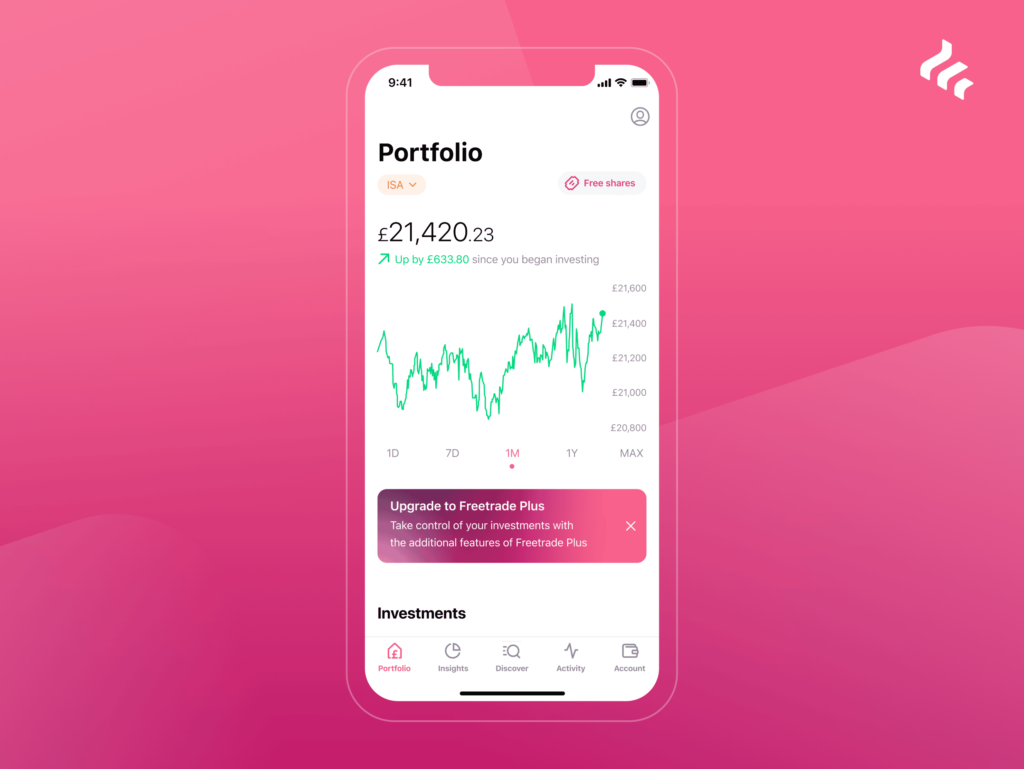
Buying and selling is quick. Trades show up in your portfolio almost instantly, and you can see exactly what you paid for each holding in a couple of taps.
When I signed up, I got a free share as part of their referral promotion. Mine landed as a small stake in Nike. Free share promos change their terms fairly often, so don’t take the exact value as current, but it’s a nice bit of goodwill if you’re on the fence about trying the app.
The one thing that used to bother me is that Freetrade is app-only. I like comparing charts side by side, and that’s still awkward on a phone screen. If in-depth charting matters to you, that’s worth checking before you commit, though for straightforward long-term investing it’s rarely a dealbreaker.
Freetrade vs Trading 212
Both are solid, FCA-regulated, commission-free platforms, and I’ve used them both.
Trading 212 wins on raw cost if you trade in foreign currency: its 0.15% FX fee beats even Freetrade Plus’s 0.39%. It also offers a wider range of order types and a desktop platform.
Freetrade’s advantage is simplicity. The free plan now bundles the ISA and SIPP together with no subscription, and the app experience is genuinely easier for a first-time investor to get comfortable with.
If you’re US-stock-heavy or want more control over your orders, read my full Trading 212 review. If you want the simplest possible free ISA and SIPP setup, Freetrade is hard to beat.
You can also see how it stacks up against another popular platform in our Freetrade vs eToro comparison.
Verdict
Freetrade earns its place as one of the better beginner-friendly investing apps in the UK, and the move to a genuinely free ISA and SIPP is a real upgrade since I last reviewed it.
Rating: 4.4/5
It loses points on the FX fee for Basic users and the lack of a desktop platform. It gains them for being free where it used to charge, for solid FCA/FSCS protection, and for now sitting inside a much bigger, more established parent company.
Check out all our favourite investing apps here if you want to compare Freetrade against the rest of the market.
FAQs
Yes. Freetrade is FCA-regulated and covered by the FSCS up to £85,000 for investments. It’s owned by IG Group, a London-listed company, which adds further financial backing. It’s a legitimate, established UK investing app.
There’s no commission on trades and no fee to deposit or withdraw. The main cost is the FX fee on non-GBP purchases: 0.99% on Basic (free), 0.59% on Standard (£5.99/month), and 0.39% on Plus (£11.99/month).
Yes, since September 2025 the Stocks and Shares ISA is included on the free Basic plan. You can pay in up to £20,000 a year with no separate ISA subscription.
Yes. The SIPP has also been free on the Basic plan since January 2026, letting you invest your own pension without a monthly fee.
Yes. The app is simple, intuitive and well-suited to someone opening their first investment account. Fractional shares mean you can start with a few pounds rather than a full share price.
Freetrade is cheaper for most people. Hargreaves Lansdown charges a percentage-based platform fee on top of dealing charges, while Freetrade’s Basic plan is free and only charges an FX fee on foreign currency trades.
Freetrade has featured in Money Saving Expert investing round-ups as a low-cost app option. MSE doesn’t personally endorse specific brokers, and Martin Lewis has repeatedly warned about fake ads using his image to promote investment scams, none of which are affiliated with Freetrade or MSE.