Our Quick Verdict
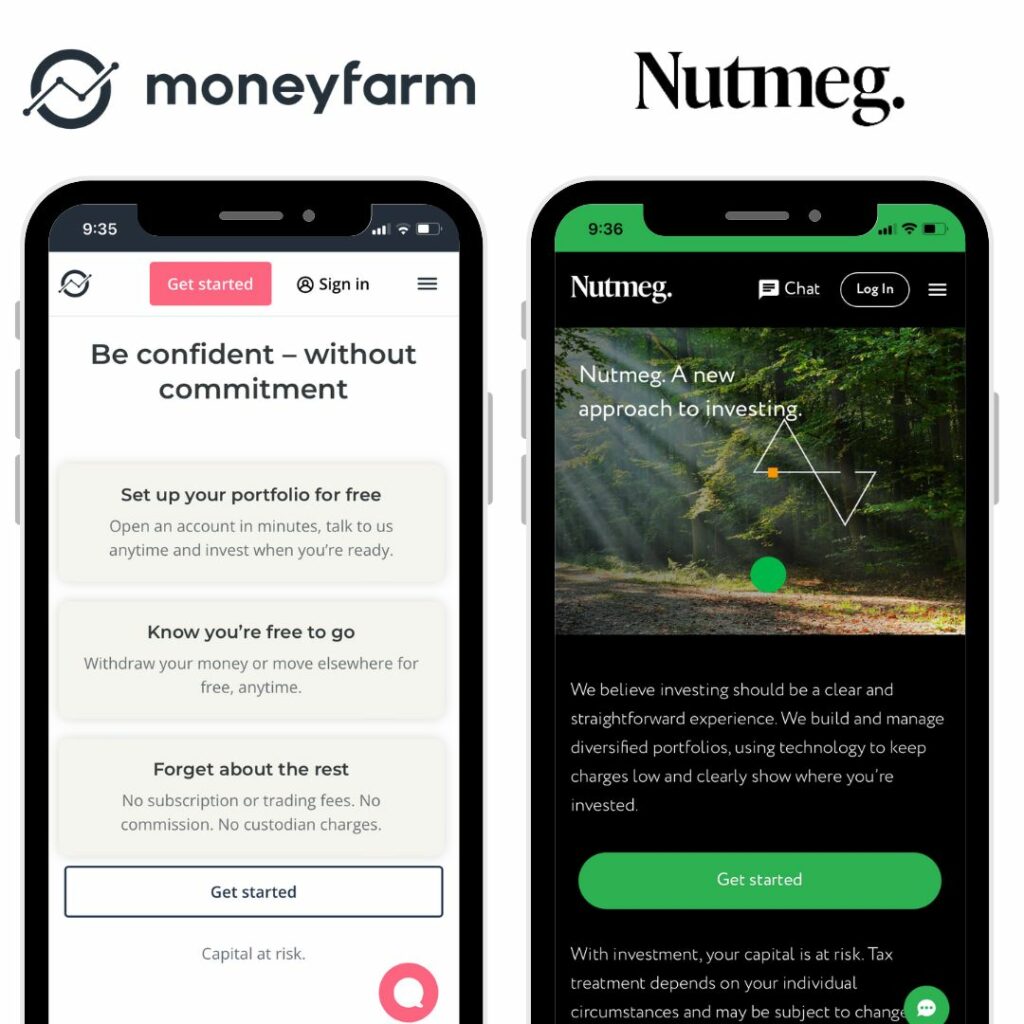
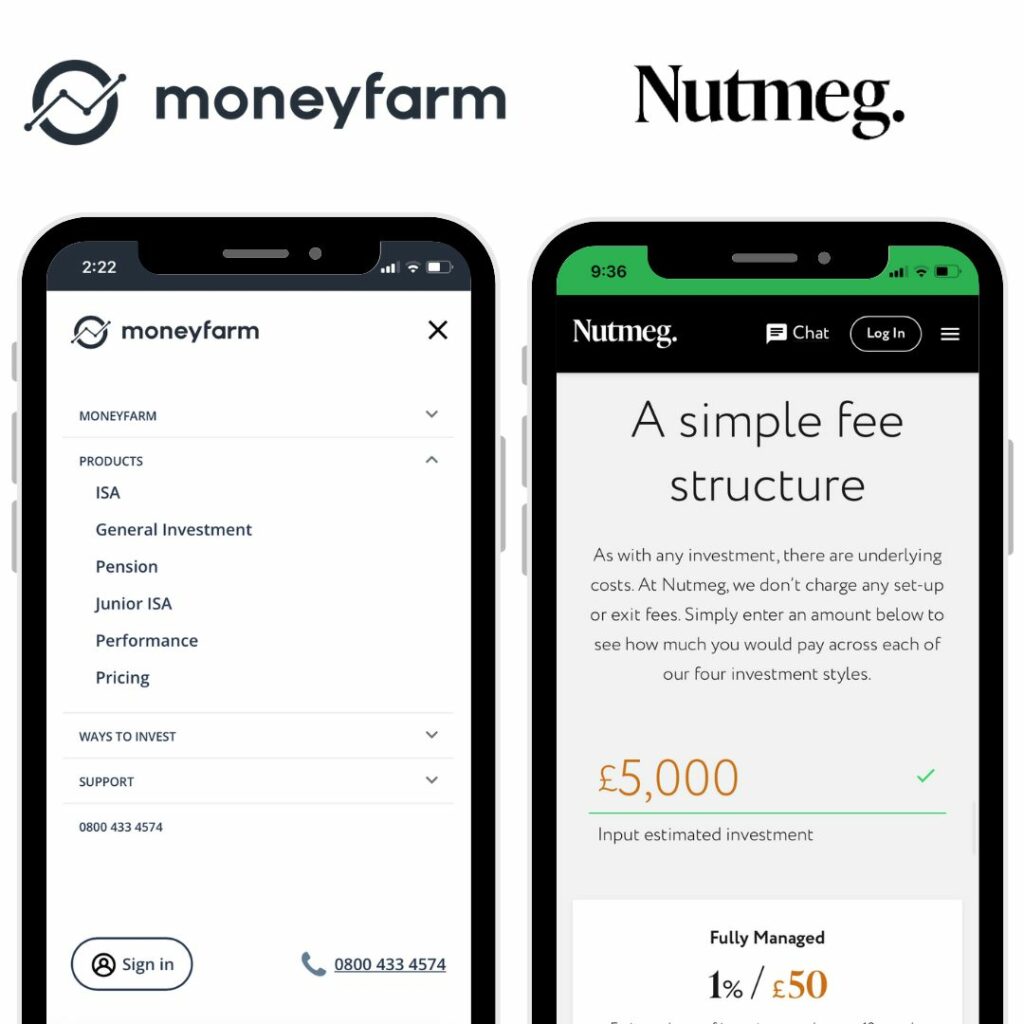
Moneyfarm is still the cheaper option at every portfolio size we tested, and the gap has widened since Moneyfarm cut its fees in 2025. J.P. Morgan Personal Investing (formerly Nutmeg) counters with the backing of one of the world’s largest banks, a wider range of investment styles, and a Lifetime ISA that Moneyfarm doesn’t offer.
Nutmeg doesn’t exist as a brand any more. In November 2025, J.P. Morgan retired the Nutmeg name it had owned since 2021 and relaunched the platform as J.P. Morgan Personal Investing. Same portfolios, same underlying service, new name and a bigger corporate badge behind it.
That rebrand doesn’t change the comparison that matters most: cost. Moneyfarm cut its own fees in 2025 and now undercuts J.P. Morgan Personal Investing at every portfolio size we’ve tested below.
Full disclosure: I hold a Moneyfarm Stocks and Shares ISA and have done for several years. I rate the product highly, and I’ll be upfront that this comparison leans on my own experience as well as the published numbers.
What Changed
Two things moved since this page was last updated:
Nutmeg became J.P. Morgan Personal Investing (3 November 2025). The portfolios, minimums and account types carried over largely unchanged; a full DIY share-dealing platform is promised for 2026 but hasn’t launched yet.
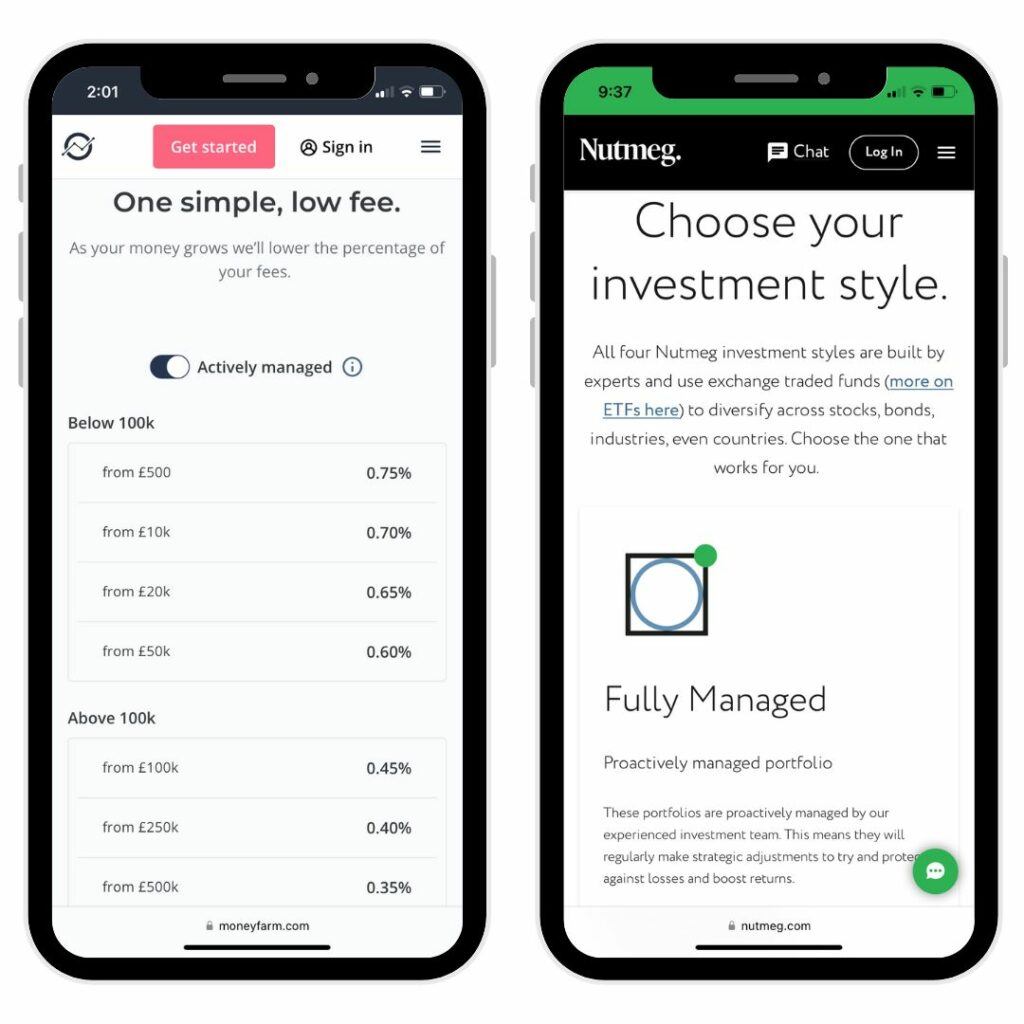
Moneyfarm cut its management fees in 2025, moving to a much lower tiered structure on its Actively Managed portfolio (0.45% down to 0.10% depending on size, versus the old 0.75%-based tiers). That’s the single biggest reason the cost gap has widened.
If you want the detail on either provider individually, read our full Moneyfarm review or our J.P. Morgan Personal Investing review.
Fees Compared
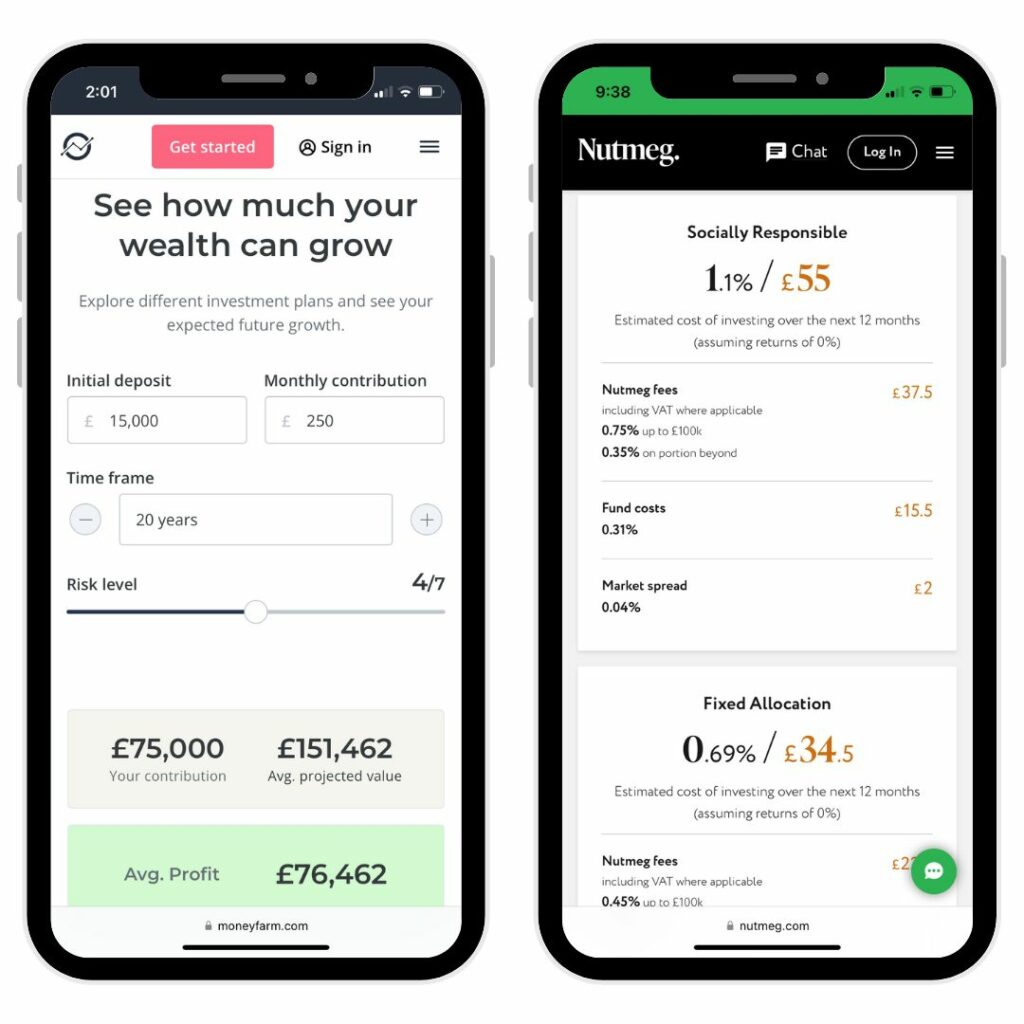
Moneyfarm’s Smart Yield and Fixed Allocation options are now meaningfully cheaper than anything J.P. Morgan Personal Investing offers at the low-risk end. J.P. Morgan Personal Investing’s Fully Managed fee only drops once you clear £100,000, whereas Moneyfarm’s tiering starts rewarding you from £50,000.
For a typical £10,000–£50,000 UK investor, Moneyfarm is cheaper by roughly £40–£100 a year depending on portfolio size:
£10,000: Moneyfarm ~£91/yr (0.91% all-in) vs J.P. Morgan Personal Investing ~£99/yr (0.99% all-in)
£50,000: Moneyfarm ~£455/yr (0.91% all-in) vs J.P. Morgan Personal Investing ~£495/yr (0.99% all-in)
£100,000: Moneyfarm ~£785/yr (0.785% all-in) vs J.P. Morgan Personal Investing ~£990/yr (0.99% all-in)
All-in figures include management fee, platform fee (where separately charged), average underlying fund costs and average spread.
Accounts Compared
Moneyfarm has pulled ahead on product range: alongside the Stocks and Shares ISA, JISA, GIA and SIPP both platforms offer, Moneyfarm now also has a Cash ISA and DIY share dealing (£3.95/trade on shares and ETFs) for anyone who wants to hold cash or pick individual stocks alongside a managed portfolio.
J.P. Morgan Personal Investing’s answer is the Lifetime ISA (LISA), which Moneyfarm doesn’t offer: £4,000/year with a 25% government bonus, usable towards a first home or retirement from 60. If a LISA is central to your plan, that alone can decide this comparison for you.
Stocks and Shares ISA
This means you have access to tax wrappers with the Stocks and Shares ISA providing up to £20,000 per annum tax-free contributions which are free from capital gains tax.
So, as your money grows you don’t have to pay tax!
Pensions
With a pension, you can invest tax-free too. You also get 25% tax relief as a bonus on your contributions which is because you’ve already paid income tax on the money.
You can’t withdraw a personal pension until you’re 55 (soon to be 57) so remember any contributions are out of bounds if you need to dip back in.
Also, remember with pensions you will be subject to tax when it comes to withdrawing it. You can take a 25% lump sum tax-free but then anything else is subject to income tax thresholds.
You can check out our best personal pensions here.
Moneyfarm’s SIPP and J.P. Morgan Personal Investing’s Pension are broadly equivalent tax-wrapper-wise: both are personal pensions with the same tax relief rules and access age.
Junior ISAs
If you’ve got kids and want to get them started early you can open a Junior ISA. On top of your £20k ISA allowance, you can invest £9,000 per year on top per child.
They can then access the money when they turn 18. What a way to set them up for life!
GIAs (General Investment Accounts)
A general investment account is a fantastic option for those who perhaps already have a Stocks and Shares ISA and are looking for wider investment opportunities.
The account doesn’t have any tax benefits and returns are subject to capital gains tax so make sure you factor this in.
J.P. Morgan Personal Investing also offers a Stocks and Shares Lifetime ISA: you can put in £4,000 per year and receive a 25% government bonus, worth up to £1,000 a year.
It’s important to note that the bonus inside Lifetime ISAs can only be used towards your first home or for retirement from 60.
Investment Styles
After you’ve selected an account it’s now time to select your investments. Both Moneyfarm and J.P. Morgan Personal Investing offer a range of styles.
Moneyfarm Investment options
Moneyfarm offers four approaches:
Actively Managed, run by Moneyfarm’s own investment team
Fixed Allocation, static and cheaper
Thematic, covering areas like technology and clean energy
ESG/Socially Responsible, ethical investing
Seven risk levels run across most of these. You are asked questions and Moneyfarm suggests a level for you, but you can also change this: it’s essentially low to high risk, and the allocations within the actively managed portfolios change to suit.
Plus you have your own investment consultant to speak with if you need advice on what’s best for you.
Each person is different when it comes to risk and you can see the past performance to help you make investment decisions.
The socially responsible investment options also make Moneyfarm very attractive here and it’s also cheaper here too.
J.P. Morgan Personal Investing Investment Options
J.P. Morgan Personal Investing offers a wider style range:
Fully Managed, run by J.P. Morgan’s team
Smart Alpha, managed using J.P. Morgan’s in-house research
Fixed Allocation
Socially Responsible/SRI
Thematic
Income
That’s a wider style range than Moneyfarm, reflecting J.P. Morgan’s asset management scale.
Moneyfarm and J.P. Morgan Personal Investing both offer socially responsible investing, where you can invest your money in the knowledge that you have no fossil fuels, tobacco or harmful products.
Moneyfarm vs J.P. Morgan Personal Investing - Socially Responsible Portfolios
If you’re interested in being a part of saving the world and investing in socially responsible companies then this is an option for you.
There’s not lots of options here it’s quite simple you just select a socially responsible portfolio and start investing.
The businesses selected within this have generated a good ESG (environmental social governance) score and focus their efforts on improving the planet or by providing services which are helpful to humans.
If style breadth matters more to you than cost, J.P. Morgan Personal Investing has the edge here. If cost matters more, Moneyfarm wins on every style we compared.
Performance
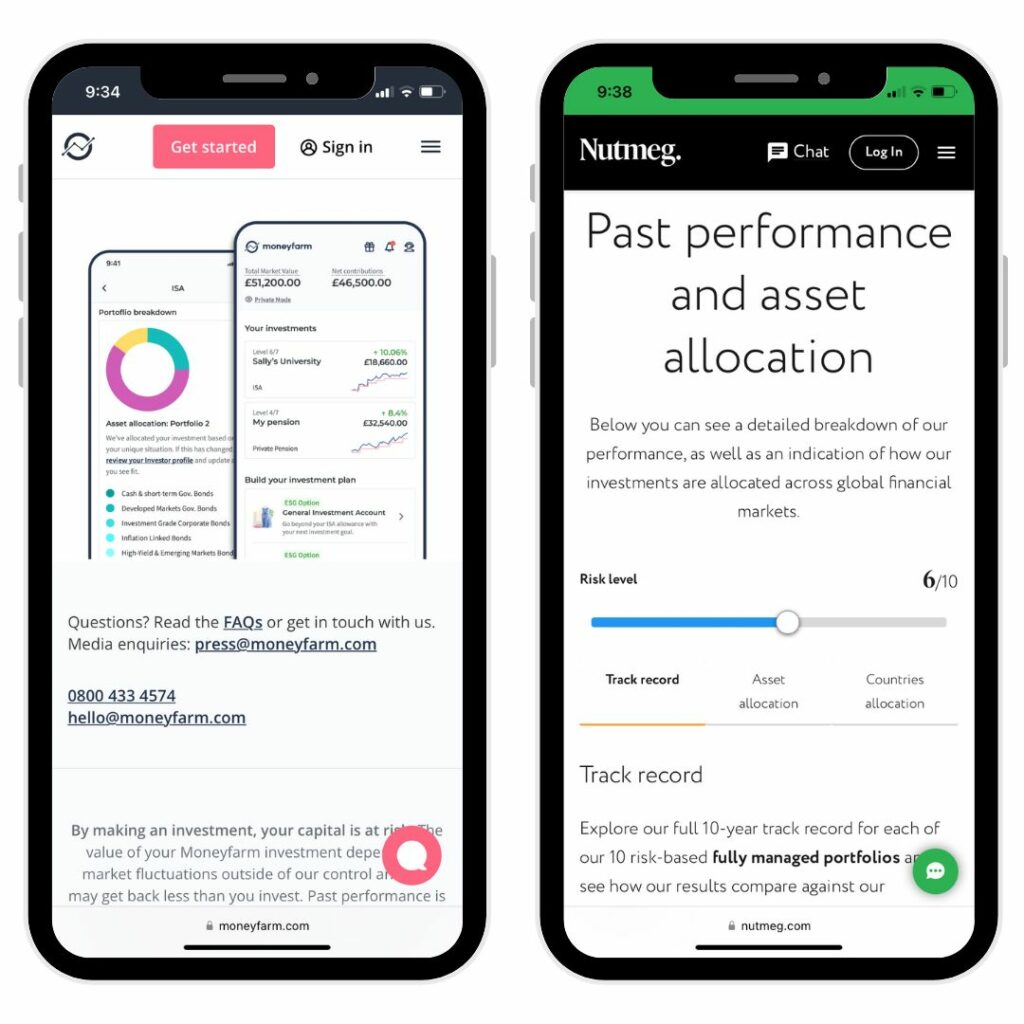
Both platforms publish their own portfolio performance figures, updated regularly, and both will show you real returns net of fees once you’re a customer. Because performance depends entirely on which risk level and portfolio you’re in, and changes every time markets move, we’d rather send you to the source than publish a snapshot that goes stale in months. Check Moneyfarm’s performance page and J.P. Morgan Personal Investing’s performance page directly before you commit, and compare like-for-like risk levels.
One thing worth flagging: the figures this page used to show were from a bear-market year (2022) where every portfolio on both platforms lost money, and they were several years out of date. Markets recover, and a single undated snapshot from a down year isn’t a fair basis for comparison.
Customer Ratings
When looking at articles across the internet and the major review sites, both platforms are ranked fairly closely. Ratings move over time, so treat the figures below as a snapshot rather than a permanent scoreboard.
J.P. Morgan Personal Investing
Moneyfarm
Are They Safe?
Yes, both are regulated by the FCA (Financial Conduct Authority). Investments and pensions held with either platform are protected up to £85,000 under the Financial Services Compensation Scheme if the firm fails. That’s separate from the £120,000 limit that applies to cash deposits, which doesn’t cover invested money.
J.P. Morgan Personal Investing sits inside one of the world’s largest banking groups; Moneyfarm’s largest shareholder is the insurer Allianz, alongside M&G and Poste Italiane. Neither backing changes your FSCS cover, but it’s worth knowing who’s behind each brand.
Who Should Pick Which?
Pick Moneyfarm if: cost is your priority, you want a Cash ISA or DIY share dealing alongside your managed portfolio, or you want the cheapest realistic route into a low-risk portfolio (Smart Yield at 0.05%).
Pick J.P. Morgan Personal Investing if: you want a Lifetime ISA, you want the widest range of investment styles (Smart Alpha, Income, Thematic all in one place), or you’re already a Chase UK customer and want everything in one app.
What About Wealthify?
If you’re searching “Wealthify vs Nutmeg vs Moneyfarm”, here’s the short version: Wealthify is the budget option of the three. It charges roughly 0.60% management plus fund costs, undercutting J.P. Morgan Personal Investing’s 0.75% Fully Managed fee but still costing more than Moneyfarm’s cheapest tiers. Wealthify’s product range is simpler too, built for straightforward “pick a risk level and go” investing rather than the multiple style options Moneyfarm and J.P. Morgan Personal Investing both offer.
Where Wealthify wins: a lower minimum than either rival and Aviva’s backing if brand trust matters to you.
Where it loses: no DIY share dealing, no SIPP flexibility to match Moneyfarm’s, and a narrower set of portfolio styles than J.P. Morgan Personal Investing.
For the full breakdown, see our Moneyfarm vs Wealthify comparison.
Alternatives
Being part of the robo-advisor clan means there aren’t many other true competitors in the market.
If you’re looking for the best investing apps for beginners, head to our page there. This features the likes of InvestEngine, Moneybox and more.
You can also check our Moneyfarm vs Moneybox review here too.
FAQs
Verdict
Both platforms remain strong robo-advisors, and the rebrand doesn’t change what J.P. Morgan Personal Investing actually offers day to day. But on cost, Moneyfarm has pulled further ahead since its 2025 fee cut, undercutting J.P. Morgan Personal Investing at every portfolio size we tested, and it now backs that up with a Cash ISA and DIY dealing that J.P. Morgan Personal Investing can’t match yet.
If a Lifetime ISA or the widest possible range of investment styles is what you need, J.P. Morgan Personal Investing is the better fit. For most people prioritising fees, Moneyfarm remains the better value pick.