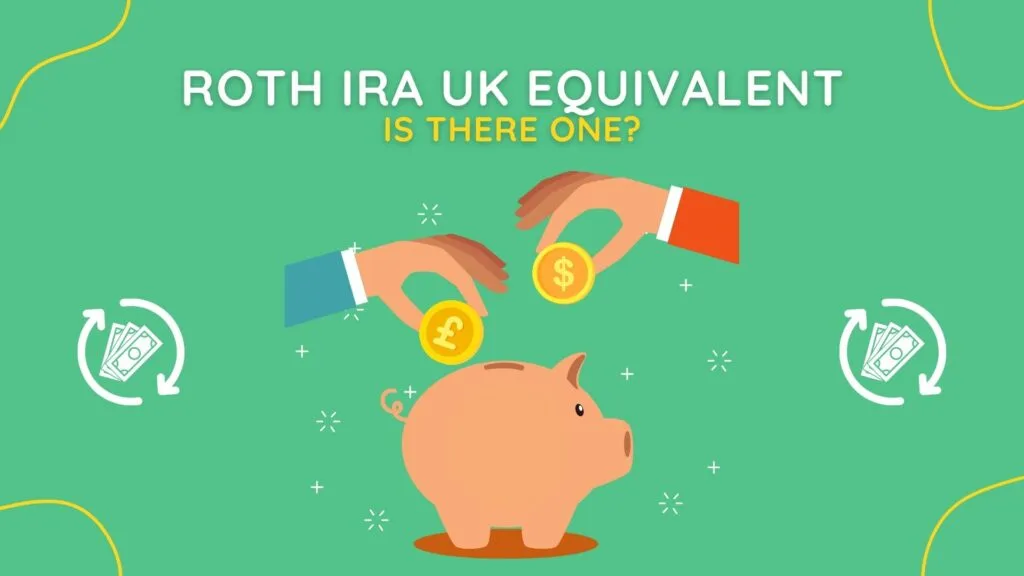
The UK doesn’t have a Roth IRA. The closest UK equivalent is the stocks and shares ISA: you pay in money you’ve already been taxed on, it grows tax-free, and everything you take out is tax-free too. That’s exactly how a Roth IRA works in the US.
If you’re under 40, the Lifetime ISA is the second-closest match, because it’s built for later life (and first homes) and comes with a 25% government bonus. And if you’re looking for the Traditional IRA UK equivalent, that’s a SIPP, which gives you tax relief going in and taxes you coming out.
Budget update, 28 October 2026: the £20,000 ISA allowance is unchanged, and the 22% charge on cash held in stocks and shares ISAs that was planned for April 2027 has been scrapped. An earlier version of this page said that charge would apply. I cover the 401(k) UK equivalent in a separate guide.
What is a Roth IRA? (For UK readers)
A Roth IRA is a US individual retirement account. You pay income tax first, put the after-tax money in, and it grows free of US tax. Withdrawals in retirement are tax-free too, as long as you meet the rules.
It’s the opposite of a Traditional IRA or a standard 401(k), where you get tax relief on the way in and pay tax on the way out. The key numbers for 2026:
- Contribution limit: $7,500 a year, or $8,600 if you’re 50 or over.
- Income limit: the amount you can pay in is phased out between $153,000 and $168,000 of income for single filers, and between $242,000 and $252,000 for married couples filing jointly.
- Access: you can take out what you paid in at any time. Growth comes out tax-free once you’re 59½ and the account is at least five years old. Take growth out earlier and you usually pay tax plus a 10% extra charge, with some exceptions, such as up to $10,000 for a first home.
- No forced withdrawals: you can leave money in a Roth IRA for as long as you live.
A 401(k) is something else again: an employer-sponsored plan. A Roth IRA is an individual account with after-tax contributions. Different structure, different rules.
New to investing?
Get my free Checklist: the steps I would follow to open and fill an ISA without the classic mistakes. Plus one email a week, unsubscribe any time.
The closest UK equivalent: the stocks and shares ISA
The stocks and shares ISA is the closest UK version of a Roth IRA. Here’s why the match is so clean:
- You pay tax on your income first, then pay in after-tax money.
- Your investments grow tax-free inside the ISA: no tax on dividends, interest or capital gains.
- Withdrawals are tax-free at any age, for any reason.
- There’s no lock-up period.
The differences make the ISA arguably more flexible than a Roth IRA:
- Higher limit: £20,000 a year, against $7,500 for a Roth IRA.
- No income cap: high earners can pay in the full amount.
- No age rules on withdrawals: pull the money out at 25, 45 or 65 with no extra charge.
- Spend it on anything: a house, a business, a sabbatical. No penalty calculation needed.
Where the Roth IRA holds an edge: it’s recognised by the US tax system and the ISA isn’t, which matters if you’re a US citizen (more on that below). For anyone who only pays UK tax, the ISA does everything a Roth IRA does and more.
To show what that higher limit can do: put £20,000 in at the start of every year for 25 years, and at an example 5% a year after fees you’d have about £1 million, from £500,000 paid in. Growth isn’t guaranteed and investments can fall, but none of that growth or the withdrawals would be taxed in the UK.
Sammie's pick for a DIY stocks and shares ISA

Trading 212
Commission-free shares and ETFs in an ISA, Invest account or SIPP
Offer: Free fractional shares worth up to £100 with promo code GAINS (code must be used within 10 days of registering; value is random, most awards £8 to £25). Capital at risk, T&Cs apply.
- Commission-free trading, no account fee
- Pays interest on uninvested cash
- Stocks ISA and SIPP in one app
- CFDs in the same app: 77% of retail accounts lose money
- 0.15% FX fee each way on non-GBP trades
- Card deposits cost 0.7% after your first £2,000
- No Junior ISA or Lifetime ISA
- £1
- minimum
- Free
- platform fee
- Free
- trading fee
- 0.15% FX fee on non-GBP trades
Affiliate link. Capital at risk.
For a full provider comparison on fees and features, see my round-up of the best stocks and shares ISAs, or read my full Trading 212 review. When you invest, your capital is at risk.
The Lifetime ISA: the retirement-specific option
If you want something closer to the retirement-only nature of a Roth IRA, the Lifetime ISA (LISA) is a narrower match, but a strong one for the right person. Here’s how it works:
- Open it at 18 to 39 and pay in up to £4,000 a year until you’re 50. It counts towards your £20,000 ISA allowance.
- The government adds a 25% bonus on what you pay in, up to £1,000 a year.
- It can hold cash, investments or both, and everything grows tax-free.
- Withdrawals are tax-free for a first home costing £450,000 or less, or from age 60.
- Take money out for anything else and you pay a 25% charge, which takes back the bonus and a bit of your own money. From 29 October 2026, the charge is 20% if you use it for a first home costing more than £450,000.
Where the LISA beats the Roth IRA: that 25% bonus is free money no US account offers. Pay in the full £4,000 every year from 18 until 50 and that’s around £32,000 of government top-ups.
Where it loses: it’s locked until 60 for retirement use, the annual limit is lower, and the charge for using it any other way is harsher than the Roth IRA’s 10%.
My take: if you’re eligible (under 40 when opening), the LISA is one of the most under-used tools in the UK. The 25% bonus on retirement savings is a genuine outlier among UK tax wrappers.
One change on the horizon. From April 2029 a new First Time Buyer ISA replaces the Lifetime ISA for new savers, and it’s for first homes only, with no retirement use. If you open a Lifetime ISA before then, you can keep paying in and using it under the current rules. Full details are in my guide to how a Lifetime ISA works.
 Read nextHow to Get Out of Debt: How I Cleared £24,000 in 18 Months
Roth IRA vs stocks and shares ISA vs Lifetime ISA
| Feature | Roth IRA (US) | Stocks and shares ISA (UK) | Lifetime ISA (UK) |
|---|---|---|---|
| Tax on money going in | After tax | After tax | After tax, plus a 25% bonus |
| Tax on growth | Tax-free | Tax-free | Tax-free |
| Tax on withdrawals | Tax-free from 59½ (account open 5 years); contributions any time | Tax-free, any time | Tax-free for a first home or from 60 |
| Annual limit (2026) | $7,500 ($8,600 if 50+) | £20,000 | £4,000 (within the £20,000) |
| Income cap | Yes, phased out | No | No |
| Age to open | Any age with earned income | 18+ | 18 to 39 |
| Early withdrawal charge | Tax plus 10% on growth before 59½, with exceptions | None | 25% (20% for a first home over £450,000) |
| Government bonus | None | None | 25%, up to £1,000 a year |
| Investments | Shares, ETFs, bonds, mutual funds | Shares, ETFs, funds, investment trusts, bonds | Shares, ETFs, funds (cash Lifetime ISAs too) |
| Best for | US taxpayers saving for retirement | UK savers who want flexibility | UK savers under 40 buying a first home or saving for later life |
The ISA beats the Roth IRA on contribution limit and flexibility. The Lifetime ISA beats everything on the government bonus, but only if you can live with the age and use restrictions.
What about the 401(k)?
You’ve probably heard “401(k)” in US finance content too. It’s the US employer-sponsored retirement plan, not the same thing as a Roth IRA. In the UK, the closest equivalent is a workplace pension (for the employer contributions) combined with a SIPP (for investment control).
There’s no UK version of a Roth 401(k). UK workplace pensions give you tax relief going in, not after-tax contributions, so the stocks and shares ISA is what fills the “after tax in, tax-free out” gap. My full guide is here: 401(k) UK equivalent: workplace pension and SIPP.
What is the Traditional IRA UK equivalent?
A Traditional IRA works the opposite way to a Roth IRA: you get tax relief going in, the money grows tax-free, and you pay tax when you take it out. The UK equivalent is a SIPP, a self-invested personal pension.
- Tax relief going in: pay £80 into a SIPP and the government adds £20 to make it £100. Higher and additional rate taxpayers can claim more back through their tax return.
- Tax coming out: usually 25% comes out tax-free (up to £268,275), and the rest is taxed as income.
- Access: from 55, rising to 57 on 6 April 2028.
- Limit: up to £60,000 a year including employer payments, with tax relief on your own payments up to 100% of your earnings. A Traditional IRA is capped at $7,500.
Where the SIPP beats the Traditional IRA: a much higher limit, a tax-free lump sum the IRA doesn’t have, and no forced withdrawals. Traditional IRAs make you start taking required minimum distributions from age 73, while UK pensions let you leave the money invested.
One thing to know before 2027: from 6 April 2027, unused pension pots count towards your estate for UK inheritance tax. I compare the two UK options head to head in SIPP vs ISA, and the main providers are in my pension providers comparison. Trading 212 now offers a SIPP alongside its ISA.
Can you open a Roth IRA in the UK?
Short answer: no, not if you only pay tax in the UK. A Roth IRA is a US tax account, opened with a US provider. To pay in, you need earned income that’s taxable in the US, which usually means you’re filing a US tax return.
- If you’re a UK citizen with no US tax status: you can’t open or pay into a Roth IRA. The ISA, Lifetime ISA and SIPP are your route.
- If you’re a US citizen living in the UK: you may still be able to pay in if you have enough income that’s taxable in the US. Under the UK-US tax treaty, qualifying Roth IRA withdrawals paid to a UK resident are generally free of UK tax to the same extent they’re free of US tax. But if you exclude your foreign earnings from US tax, you may have no income left to contribute against, and the rules get complicated quickly.
- If you’re a Brit moving to the US: once you’re a US taxpayer with earned income, you can open a Roth IRA. Your UK ISAs can’t be moved into it.
US citizens should be careful with ISAs. The US doesn’t recognise an ISA’s tax-free status, so gains and income inside it are still taxable in the US, and many UK funds count as foreign investment funds, which the US taxes harshly. Cross-border planning is genuinely complex, so speak to a US-UK tax specialist before acting.
New to investing?
Get my free Checklist: the steps I would follow to open and fill an ISA without the classic mistakes. Plus one email a week, unsubscribe any time.
Roth IRA UK equivalent: FAQs
Is there a Roth IRA in the UK?
No. The Roth IRA is a US account governed by US tax law. The closest UK equivalent is the stocks and shares ISA: after-tax money in, tax-free growth, tax-free withdrawals. Its £20,000 yearly limit is far higher than the Roth IRA’s $7,500, and there’s no age restriction on withdrawals.
Can a US citizen living in the UK use a stocks and shares ISA?
You can open one as a UK resident, but the US doesn’t treat it as tax-free, so the gains and income are still taxable in the US, and UK funds inside it can fall under harsh US rules for foreign funds. Many US citizens in the UK avoid or limit ISAs. Speak to a cross-border tax adviser first.
Is a SIPP the same as a Roth IRA?
No. A SIPP is the UK equivalent of a Traditional IRA: tax relief going in, tax paid when you take money out. A Roth IRA is the opposite, which is why the stocks and shares ISA is the closer match.
Can I transfer my Roth IRA to a UK ISA?
No. A Roth IRA can only be held with a US provider. If you move to the UK, it stays in the US and you start fresh with UK ISAs. How withdrawals are taxed across both countries is complex, so get professional advice.
Does the UK have anything like a Roth 401(k)?
Not directly. UK workplace pensions give tax relief going in rather than taking after-tax money, so there’s no Roth-style workplace pension. A stocks and shares ISA fills the after-tax-in, tax-free-out gap.
What’s the UK equivalent of a Traditional IRA?
A SIPP. It follows the same tax relief in, taxed out model, with a much higher limit: up to £60,000 a year including employer payments, against $7,500 for a Traditional IRA.
If I’m starting from scratch in the UK, which accounts are worth knowing about?
Most UK savers combine three things: a workplace pension (auto-enrolment usually sets this up for you), a stocks and shares ISA, and, if they’re under 40 and saving for a first home or later life, a Lifetime ISA. A SIPP is an optional extra for more investment choice.
Are ISAs changing in 2027?
Less than expected. The 28 October 2026 Budget kept the cash ISA limit at £20,000 and scrapped the planned 22% charge on cash in stocks and shares ISAs, so the stocks and shares ISA works as it does now. More in my guide to the 2027 ISA changes.
The verdict: which UK account replaces the Roth IRA?
For most UK savers, the stocks and shares ISA is your Roth IRA. You get the same after-tax-in, tax-free-out mechanic, with a higher annual limit and no age restriction.
For retirement-specific savings, the Lifetime ISA adds a 25% bonus on up to £4,000 a year if you’re under 40, alongside the main ISA rather than instead of it. For pension-style tax relief going in, the SIPP is the UK’s answer to the Traditional IRA.
If I had to boil it down to one line: ISA = Roth IRA, SIPP = Traditional IRA, workplace pension + SIPP = 401(k). Not perfect analogies, but close enough for planning.
Best Stocks and Shares ISAs 2026
The investing ISAs I rate, compared on fees, features and offers.
See the ISAs